



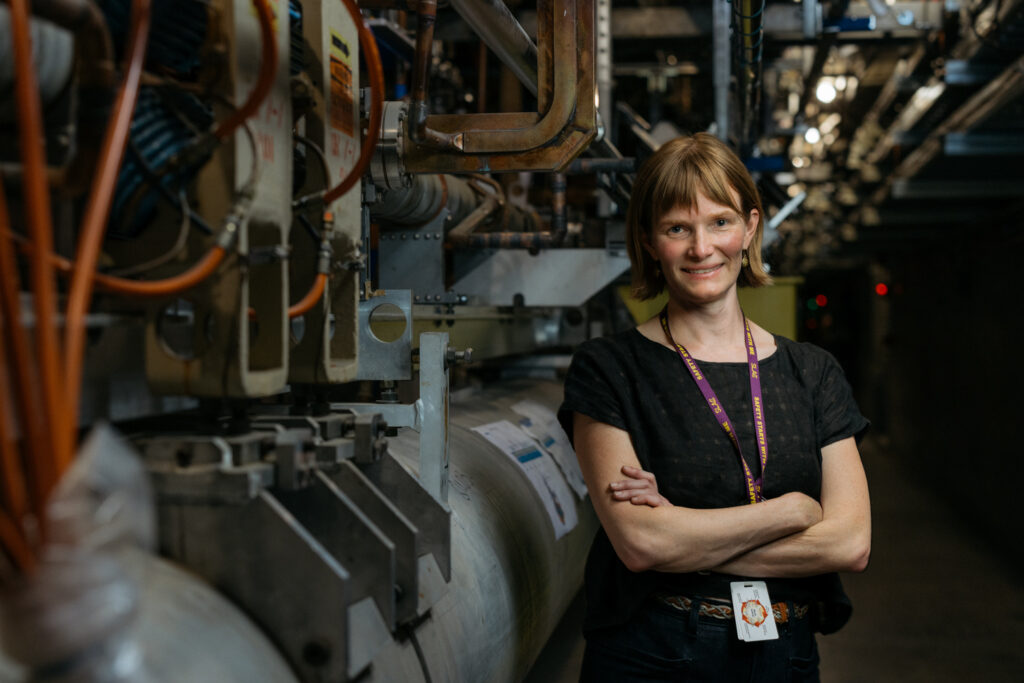
Stanford physicist Lauren Tompkins is trying to solve the mysteries of the universe with subatomic particles
In the “Research Matters” series, we visit labs across campus to hear directly from Stanford scientists about what they’re working on, how it could advance human health and well-being, and why universities are critical players in the nation’s innovation ecosystem. The following are the researchers’ own words, edited and condensed for clarity.
If you take that question that kids always ask – “But why? Why is it like that? Why does that happen?” – and just keep asking it, you might end up studying particle physics. Particle physicists try to describe you, me, and the universe in terms of indivisible particles and forces.
But, even with our most sophisticated theories of physics, we can only describe 5% of the universe. The rest is a mystery and dark matter is a major part of that unknown. We have abundant evidence for dark matter from cosmology and astrophysics. We suspect that it’s made of particles – because everything else is – but we don’t yet have a candidate particle for dark matter.
I use particle accelerators to study the fundamental structure of matter. Right now, I’m using several accelerators to try to produce dark matter in the lab.
At the Large Hadron Collider at CERN in Switzerland, we’re colliding protons at the highest energies ever achieved by humans on Earth. And we’re looking for, essentially, weird stuff. That includes collisions where a large fraction of the product appears to be “missing.” What’s “missing” might be evidence for dark matter. We’re also hoping to build an experiment at SLAC where an electron beam hits a thin target; if electrons go in and almost nothing comes out, that too could be evidence of dark matter.