
 How to resolve AdBlock issue?


Tourismtoday
From Tourist Tax to Smart Tourism Governance
Citytax: The silent revolution transforming the digital management of tourism destinations
Tourism digitalisation is no longer limited to improving visitor experiences or promoting destinations through online platforms. A new generation of GovTech and Tourism Tech solutions is beginning to transform one of the most complex and least visible areas of tourism management: the control, taxation and governance of tourist accommodation.
In this context, Citytax emergedemerges as a Lithuanian tourism-tech company specialising in digital infrastructure for tourist tax management
accommodation registration and the detection of unregistered short-term rentals.
The company is built around a simple yet powerful idea:
“You can only tax what you can see.”
This principle summarises one of the major challenges currently facing many European tourism destinations: a significant part of the accommodation market remains outside official systems, particularly in the short-term rental sector.
For years, many municipalities have managed tourist taxes through manual processes, paper declarations, complex calculations and fragmented systems.
The result has been a combination of administrative burdens for accommodation providers, friction for tourists and a lack of visibility for public administrations. This has led to lost revenues, delays in collecting essential information and legal disputes that overload courts due to a lack of clarity, speed and effective resolution.
Citytax proposes replacing, simplifying and unifying these procedures through an integrated digital platform capable of automating tax collection, registering accommodation providers, verifying operators, generating reports and providing municipalities with real-time dashboards, while remaining flexible enough to adapt to the specific needs of each administration.
The solution also improves transparency, reduces administrative workload and creates a more reliable database for public decision-making, helping prevent conflicts between stakeholders and public authorities.
The project is led by a team combining extensive tourism expertise with advanced technological capabilities.
Julian Ipsen brings 25 years of experience in the tourism sector, having worked for tour operators, destination marketing organizations and public institutions on 4 continentsthe tourism administration of Saxony, Germany.
Meanwhile, Virginijus Kandrotas leads the company’s technological architecture and DevOps development, following a long career in software engineering, cybersecurity and , data protection for Startups and multinational cooperationsand projects connected with Bosch.
As the team developed automation solutions for tourist tax management, it became clear that the real challenge went far beyond local taxation. The central issue was the lack of genuine visibility into the tourism accommodation ecosystem.
This is where StayRadar, one of the strategic modules within the Citytax ecosystem, comes into play.
StayRadar identifies accommodation listings that appear on online platforms but are not included in official municipal registers. Through intelligent, customised data analysis and comparison, the platform helps detect, locate and identify potential unregistered rentals and areas with limited administrative traceability.
The tool is not designed to penalise responsible hosts, but rather to create a fairer and more transparent market.
For municipalities, it provides more accurate information about tourism capacity, visitor flows and the real evolution of the market, enabling better budget planning, event organisation and access to grants and public funding.
Citytax is already operating internationally
Ukraine has become one of the most advanced examples of this new approach to digital tourism governance.
As part of the GovTech Lab Ukraine programme, Citytax is working together with the State Agency for Tourism Development of Ukraine (DART) on UTEM — Unified Tourism Ecosystem Modules.
UTEM is designed as a modular digital infrastructure for registering accommodation providers, verifying tourism operators, collecting structured statistics and creating a solid foundation for future tourism taxation management.
The system includes four main modules:
- accommodation registration;
- unique property identification;
- statistical data collection;
- interactive tourism data visualisation.
The initiative addresses a particularly serious structural problem in Ukraine: between 50% and 60% of accommodation advertised on digital platforms is not officially registered. In some communities dominated by private homes and guesthouses, up to 80% of potential tourist tax revenue never reaches municipal budgets.
The project is also directly connected with the new European regulation on short-term tourist rentals. European Regulation 2024/1028 establishes new frameworks for data collection, registration numbers and information exchange between platforms and public authorities.
In this new environment, solutions such as Citytax are no longer simply tax collection tools. They are becoming genuine operating systems for the smart tourism destinations of the future.
The combination of digital taxation, market intelligence, data visualisation and accommodation verification points towards a new model of tourism governance: more transparent, interoperable and based on real evidence.
According to Laura Luján, responsible for Citytax’s expansion and business development in Spain:
“In the smart tourism of the future, managing a destination effectively will start with something very basic: truly knowing what is happening within it.”
This platform can help solve the internal digitalisation challenges currently faced in Spain, where recent cases involving platforms such as Airbnb have highlighted problems related to registration systems, sanctions, administrative conflicts and court saturation.
Citytax offers a solution to interconnect existing regional accommodation registers with the new digital models required by European regulations, among other capabilities.
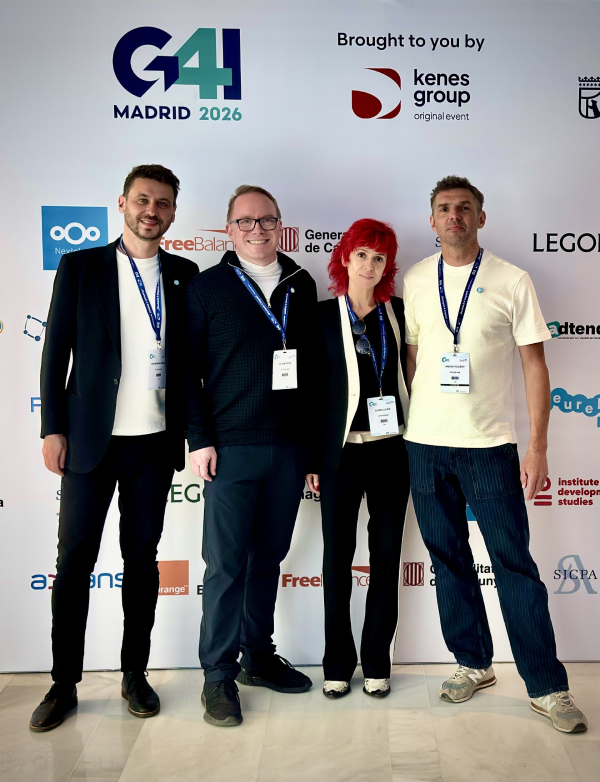
Image: Max Martinchick, Julián Ipsen, Laura Luján y Andrey Glebow
Tags :