




It is a system, which combines IoT and AI, that can detect vehicles without the intention of stopping at junctions
A unique innovation in Europe arrives in Las Rozas to protect pedestrians with disabilities. From today, the city of Las Rozas becomes the first municipality to test a pioneering technology on the street: a system that detects cars that do not brake at pedestrian crossings. It is a pilot project, WALKERPISA Project, which comes from the ONCE Foundation, together with Las Rozas Innova -Municipal Innovation Company of the City of Las Rozas-, and which aims to improve safety at pedestrian crossings for people with visual, hearing or intellectual disabilities.
The technology of the “WALKERPISA Project” will be tested for two and a half months in a real urban environment and with real users after being validated in controlled environments. It is an innovative combination of cutting-edge technologies, such as the Internet of Things (IoT) and Artificial Intelligence (AI)– which are commonly used in aerospace, industrial or defence sectors – and is now being applied to urban accessibility.
“With this pilot, Las Rozas continues to position itself among the European cities that are committed to advanced technological solutions to build a more efficient, inclusive and safe urban model,” says José de la Uz, mayor of Las Rozas and president of Las Rozas Innova.
Technology: IoT and AI for urban accessibility
The technology has been developed by SINGULAR THINGS and consists of a series of beacons equipped with sensors (LiDAR technology) that, placed next to pedestrian crossings, can detect vehicles without the intention of stopping, which, therefore, can constitute a danger for pedestrians with some type of disability. The beacons are capable of anticipating the risk and warning any pedestrian’s mobile devices or smartwatch in advance through a mobile application (PISA app) that can be synchronised with a smartwatch and emit haptic (vibration), sound and visual signals.
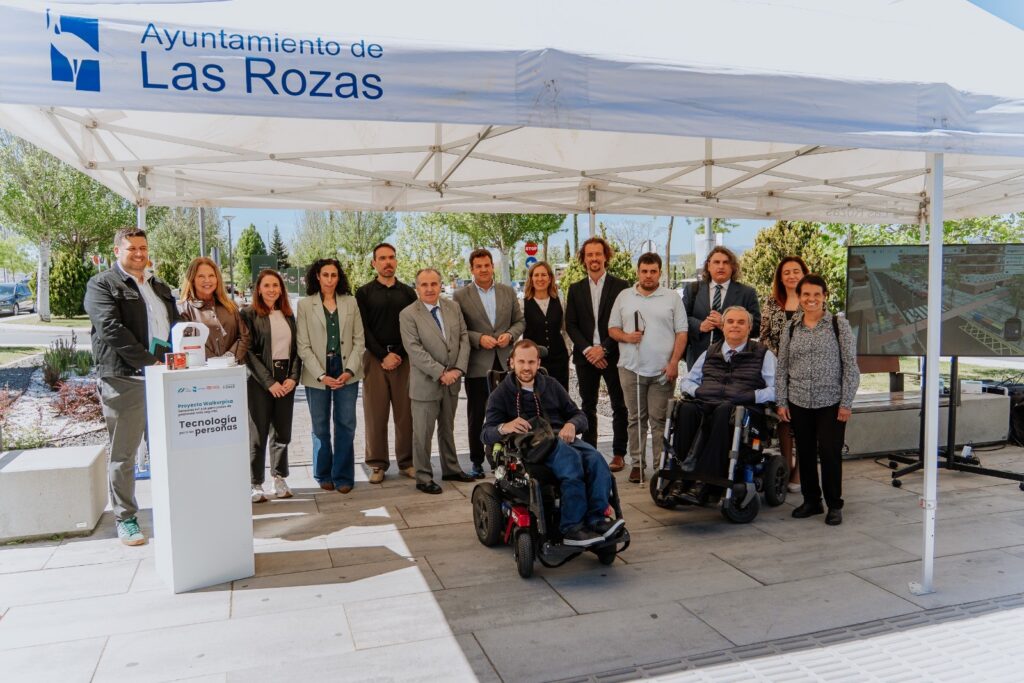
This morning, Jesús Hernández, the Director of Accessibility and Innovation of the ONCE Foundation, visited together De la Uz the test environment in which the pilot project starts today: one of the pedestrian crossings with the most influx in the city, which is located on the boulevard of Camilo José Cela street, between Heron City and Las Rozas Village, where it will be evaluated how technology can reduce risks at crossings without traffic lights. The presentation was also attended by Almudena Alcaide, Director of R+D+i Fundación ONCE, and Javier Pascual, CEO of Singular Things.
Jesús Hernández, emphasised that “the implementation of projects such as Walkerpisa highlights the importance of collaboration between public and private entities to promote innovation with social impact. Initiatives developed by actors such as Las Rozas Innova show that, when administrations, technology companies and social organisations work in a coordinated way, it is possible to advance in solutions that improve safety, accessibility and, ultimately, the quality of life of people with disabilities, contributing to building more inclusive and intelligent urban environments”.
“For Las Rozas it is a priority to continue advancing in technological solutions that improve the quality of life of all people. This pilot is especially relevant to us because Las Rozas is a city without traffic lights and where we are convinced that technology can increase safety and offer more autonomy to people with special needs or with some mobility, vision or hearing difficulty. Collaborating with the ONCE Foundation in a pioneering project such as WALKERPISA is a further step in our commitment to an innovative city and to technology as a tool for urban development, social inclusion and improvement of the lives of all residents”, said José de la Uz.
A pilot to test the effectiveness and usability
These two and a half months of tests in Las Rozas will allow the technology to be evaluated in a real environment and its effectiveness in reducing risks at crossings without traffic lights, facilitating the safe transit of people with disabilities. The WALKERPISA Project will also enable technical, functional and user experience data to be collected in a dashboard with a digital twin that is capable of visualizing real time data: detected vehicles, environmental conditions and system operation.
During the trial period, people with blindness or low vision, deaf people and people with intellectual disabilities will participate as real users of the system.
Las Rozas, a testing space for innovative technology
Las Rozas Innova is the Municipal Innovation and Technological Development Company of the Las Rozas City Council, created in 2020, to promote the development of the city as a benchmark in the use of technology and innovation to improve citizen services and quality of life.
Thanks to Las Rozas Innova, Las Rozas has become an urban living lab for testing and validating innovative technology. Las Rozas, together with Las Rozas Innova, is already collaborating in 16 international R+D+i projects with a hundred cities, universities, companies and research institutes and organisations throughout Europe. The city has also become a platform for the promotion and acceleration of startups. The Las Rozas Innova Hub is the Innovation and Entrepreneurship Center of the Las Rozas City Council where more than 50 startups and companies are developing their technology with the possibility of testing their solutions innovative in real environments of the municipality and with real customers (neighbors, companies, schools, centers for the elderly).