Logistics

Optimizing supply chains with smart logistics for efficiency and sustainability.

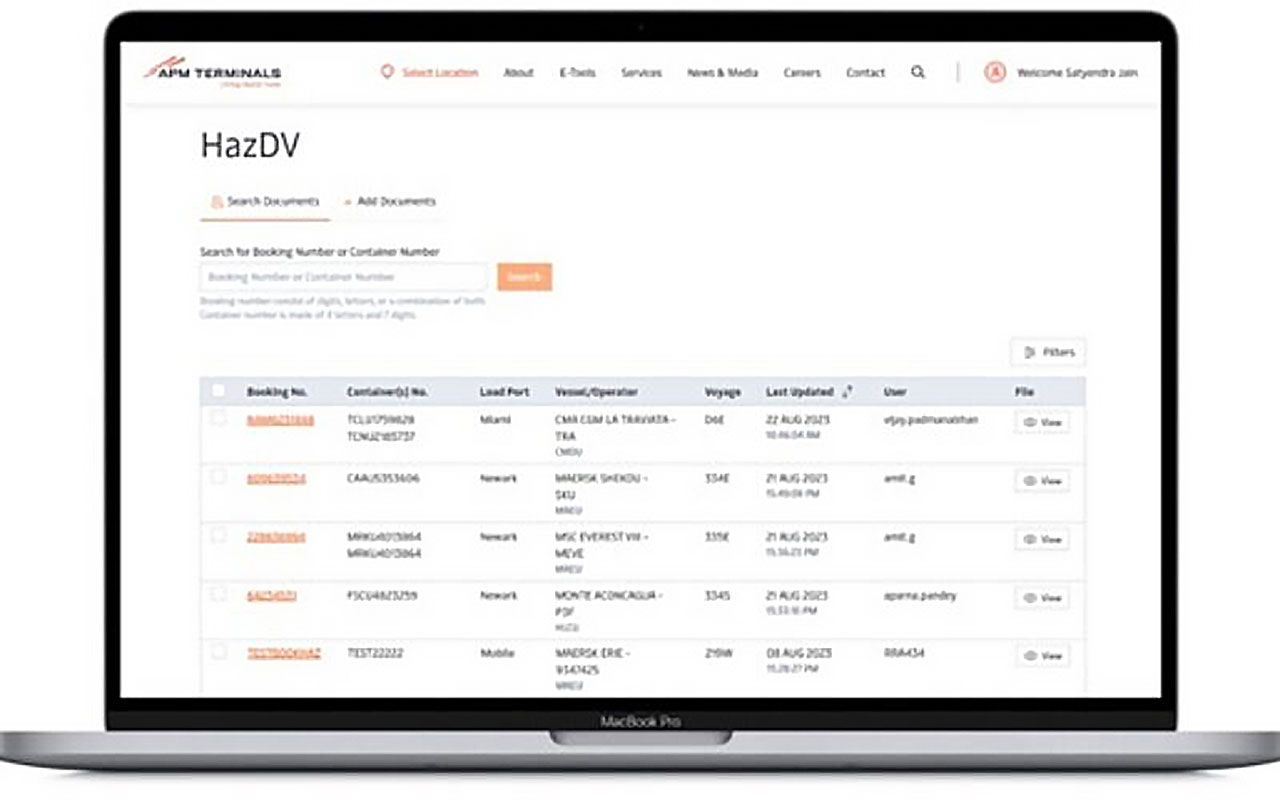
APM Terminals (APMT) has developed a new online gateway to help shipping companies manage hazardous cargo documents more efficiently

According to APMT, the initial version of the new global tool shortens the number of steps required to execute a crucial safety activity. Auto-completion and drop-down fields using standard IMDG terminology improve clarity and speed while lowering the chance of mistakes.

Known as the Hazardous Documentation Vault (HazDV), it streamlines the documentation process and contributes to data management as well as safety standards.APMT revealed that approximately 60 million TEU containers are moved throughout the world each year, with approximately 6 million containing hazardous material.

Such cargo, especially devices containing lithium-ion (rechargeable) batteries, offers an elevated risk of serious events if not handled properly, and the quantity of such things has risen dramatically in recent years.

APMT’s HazDV reportedly carries out a number of logic checks to ensure that the correct IMDG codes have been applied, so mistakes in the documentation are identified, speeding up and simplifying information flow.APMT’s online portal has already been implemented in its US terminals in Port Elizabeth, Mobile, and Miami. As with previous APMT worldwide digital solutions, it can be swiftly scaled out to additional Ports and Terminals, with plans for four more terminals in the coming months.

Source: Dom Magli (https://www.porttechnology.org/news/)

Ocean Network Express (ONE) has logged a record first quarter of the financial year riding the wave of high freight rates, in spite of softening in demand

In 1Q FY2022, ONE registered profits of $5.49 billion, an increase of $2.94 billion from the same period last year.

Although port congestion showed signs of improvement, supply chain disruptions continued around the world, including deterioration on the east coast of North America. As a result, freight rates remained significantly higher than those in the same period last year, increasing the company’s profits.

Global cargo demand in April-June remained steady despite the impact of Shanghai’s lockdown and the Ukraine crisis, according to the company.

The global cargo demand in the Asia-North America market increased by approximately 4 per cent year-on-year in April and May. The Asia-Europe market volumes in the same period registered a fall by approximately 7 per cent due to global disruptions.

ONE has laid down a conscious outlook for the rest of the year as an excessive strain on the global supply chain persists. According to the firm’s statement, it remains impossible to determine when the market will reach normal levels again, although there are signs of improvement.

Furthermore: “It has become more difficult to forecast the overall business environment in the face of increasing uncertainties such as the ongoing Russia/Ukraine crisis, the impact of China’s zero COVID-19 policy, and ILWU labour negotiations,” said ONE in its statement.

“Under these circumstances, it is therefore extremely difficult to announce a reasonable business forecast for the current financial year and as such the company’s forecasts for FY2022 are yet to be finalised.”

Source: https://www.porttechnology.org/port-news/


The container market has taken a turn in recent months, but high rates and carriers’ profits will not curb overnight as congestion still lingers at ports

In its latest Container Forecast, Drewry has pointed out that the end of the container market bull run may be close as shipments along most trade routes are down with high inflation preventing a volume bounce-back.

The decreasing demand has driven container freight rates lower week by week over the last four months. Drewry’s World Container Index shows rates declined 3 per cent just this week – 16 per cent lower than a year ago and down significantly from the September 2021’s peak.

Despite this decline, Drewry said ocean carriers are still holding the aces as there is no sign that port bottlenecks are going away soon. AIS ship tracking data has revealed that the number of containerships waiting outside of major ports is indeed growing.

“With no changes to our expected supply chain recovery timeline the market will continue to be denied capacity that it otherwise would have had access to,” says Drewry.

“We estimate that effective container ship capacity will be about 15 per cent below potential this year, following on from a 17 per cent reduction last year”.

Drewry added that China’s zero-tolerance COVID-19 policyUS West Coast port labour negotiations, and strike action across the logistics sector add to uncertainty in the market preventing a “swift normalisation”.

Drewry previously estimated that container freight rates may decline by 40 per cent in the next decade – as it predicted volatile trends in a market that could stabilise by 2024.

While congestion issues remain challenging across the world and times are not as mature as to prevent a collapse in short-term rates, Drewry noted that “the sentiment for the global economy and container demand is reasserting itself as a pricing driver”.

Looking ahead, Drewry foresees a significant loosening of the container market from the second half of 2023, when the supply chain congestion is expected to have cleared.

“The end of the containers boom cycle will require a paradigm shift from all stakeholders,” said Drewry on its container market outlook.

“Ocean carriers need to address the looming environmental and over-capacity risks by scrapping older, less green ships, while shippers might be wise to wait for the market to come back to them before committing to lengthy contracts.”


Featured

We use cookies

We use cookies on our website. Some of them are essential for the operation of the site, while others help us to improve this site and the user experience (tracking cookies). You can decide for yourself whether you want to allow cookies or not. Please note that if you reject them, you may not be able to use all the functionalities of the site.