Smart Territories

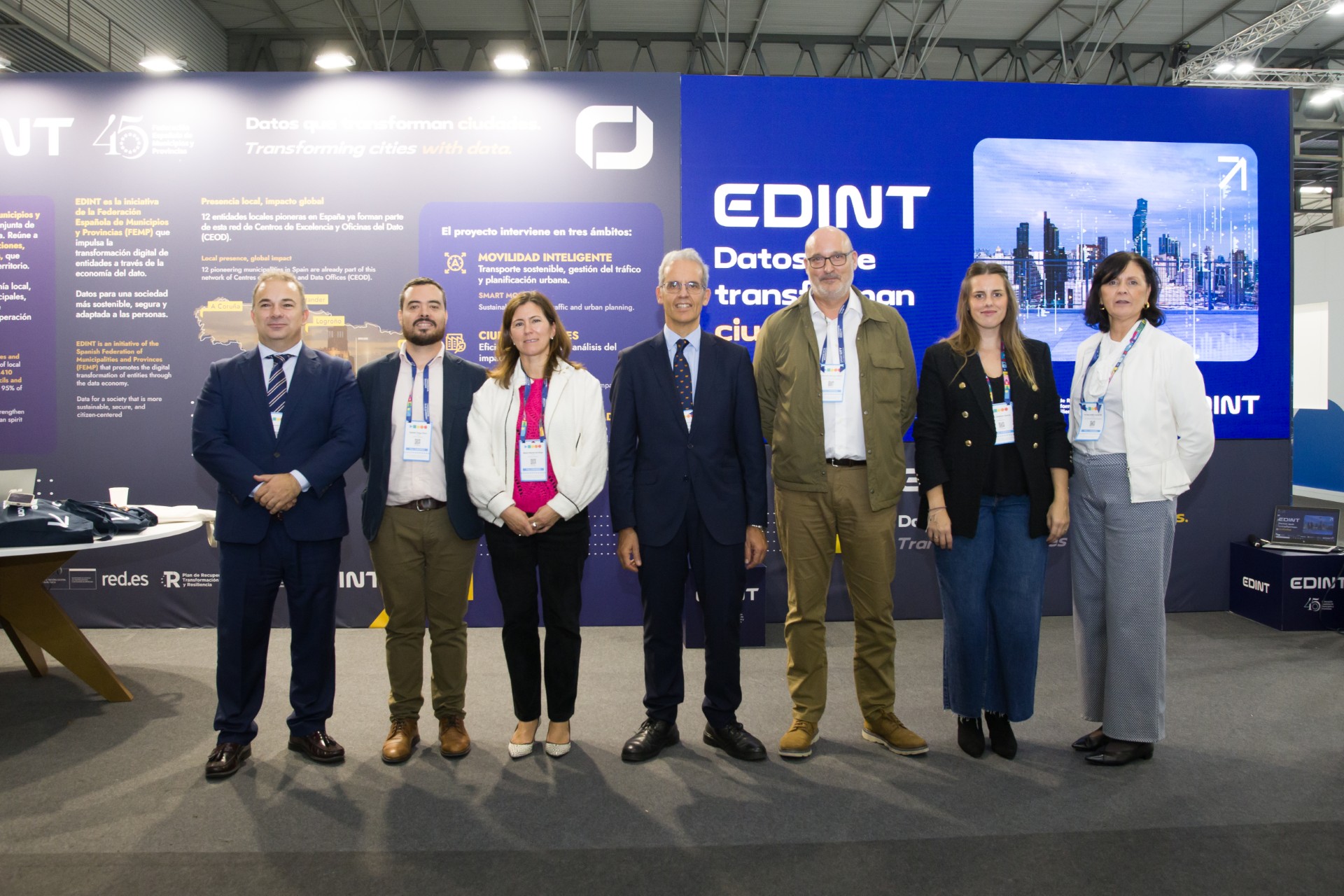
EDINT's success is based on collaboration between local governments, businesses, knowledge centres and different Spanish territories

Data has become the 'new oil': a fundamental resource that facilitates decision-making, enables process optimisation and increased productivity, and drives the transformation of the economy and society. However, the vast quantity of available information, sources and formats makes it difficult to manage and exploit its full value. To address this issue, the Spanish Federation of Municipalities and Provinces (FEMP) is promoting the EDINT project: 'Data Spaces for Smart Urban Infrastructures'. This national urban data space enables local entities to securely share, govern and utilise the data generated by smart city infrastructures. It promotes public innovation, public-private collaboration, and the development of the data economy at a local level.

EDINT has received €12.9 million in funding from the Recovery, Transformation and Resilience Plan, in collaboration with the Ministry for Digital Transformation and Public Administration, via Red.es. Under FEMP leadership, data becomes the fundamental raw material for public innovation, acquiring its maximum meaning at the local level and placing Spanish cities at the forefront of technology.

A collaborative urban data ecosystem

EDINT's success is based on collaboration between local governments, businesses, knowledge centres and different Spanish territories. The project provides a reliable environment for data exchange, the development of new digital services and evidence-based decision-making for local and supra-municipal governments, public bodies, technology and urban services companies, innovative SMEs, universities and research centres.

The project involves twelve local entities: the city councils of A Coruña, Alcoi, Fuenlabrada, Jerez de la Frontera, Logroño, Madrid, Málaga, Mataró, Santander and Valencia, as well as the provincial councils of Badajoz and Jaén. Each entity has a Centre of Excellence and Data Office (CEOD): a physical space with the necessary human and technical resources to help improve public services, promote innovation and encourage local employment within the data economy through shared management and analysis of urban data.

In this context, EDINT has identified three priority areas for action: urban mobility, the smart management of public services and local economic activity. In collaboration with the 12 CEODs and 36 private companies that have joined the project (three companies per CEOD), a catalogue of real-world applications will be created to control vehicle access in sensitive urban areas, optimise the management of urban resources and establish a Smart Urban Economic Observatory. This Observatory will integrate employment, mobility, entrepreneurship and trade data from public, private and open sources.


The institutional opening, led by the Minister of Infrastructure, Victor Coutinho, and the President of Smart City Cabo Verde, Loide Monteiro, reinforced the strategic importance of this initiative

Cabo Verde has taken a symbolic and decisive step toward the future with the official launch of Smart City Cabo Verde 2.0. More than an event, this moment marked the beginning of a new chapter in how the country thinks about, builds, and lives its cities.

Smart City Cabo Verde 2.0 is born from an ambitious vision: to position Cabo Verde as an African reference in smart, sustainable, inclusive, and resilient cities—cities centered on people, innovation, and quality of life. A vision that brings together technology and humanity, progress and identity, future and belonging.

With the support of national and international partners, including the African Development Bank, the Government of Cabo Verde, and the Municipality of São Domingos, the project stands as a true platform for the future, with the capacity to inspire and be replicated in other African cities.

The institutional opening, led by the Minister of Infrastructure, Victor Coutinho, and the President of Smart City Cabo Verde, Loide Monteiro, reinforced the strategic importance of this initiative and highlighted the role of Nos Zona Smart as a living laboratory of urban innovation—a physical and digital platform where ideas are transformed into concrete solutions.

High-level panels brought together national and international voices, with contributions from UN-Habitat, as well as financial and regulatory institutions, exploring themes such as resilient cities, green finance, artificial intelligence, tokenization, and digital public services—key areas for building cities prepared for the challenges of the 21st century.

The final message was clear and mobilizing: Smart City Cabo Verde 2.0 is a collective, open, and inclusive project that invites government, municipalities, the private sector, academia, youth, and the diaspora to be part of this transformative journey.

Together, we turn vision into reality.

And Cabo Verde stands with confidence and purpose as a true African laboratory of urban innovation, ready to lead tomorrow.

Image: Loide Monteiro in the presentation

The company promotes a global model of secure, auditable, and regulation-compliant messaging for governments and regulated institutions

In the age of instant communication, messaging applications such as WhatsApp, Signal, and iMessage have become indispensable tools for public officials. From coordinating field operations to engaging directly with citizens, these platforms reflect the way modern society communicates. Yet their widespread use raises a crucial question: how can these conversations remain compliant with legal, security, and transparency standards that define public administration?

LeapXpert is a pioneer in governed messaging for governments and regulated industries, supporting federal and SLED agencies globally as they modernize their digital communications. The surge in public-sector demand recently resulted in a strategic partnership with Iron Bow Technologies to expand LeapXpert’s reach across U.S. federal agencies. 

According to LeapXpert, the company’s communication platform allows government agencies to adopt modern messaging channels, while preserving the governance, oversight, and compliance their missions require. 

As CEO Dima Gutzeit explains, “The issue is not the use of messaging apps themselves, but the lack of a governance framework to manage them responsibly.”

Gutzeit warns that many governments face significant gaps between the convenience of instant messaging and the obligations of compliance. When officials use unauthorized channels or personal devices, those conversations fall outside the official record, undermining transparency and accountability. 

“Every message related to public business must be preserved, accessible, and auditable, just like an email or an official document,” he emphasizes.

This challenge extends across jurisdictions. In the Netherlands, the use of WhatsApp by ministers and public officials has sparked public debate, while in the United Kingdom, the Information Commissioner’s Office (ICO) has reaffirmed that official messages must be retained under the Public Records Act of 1958. In Australia, the National Audit Office has warned that unregulated communication channels pose serious risks to transparency and cybersecurity.

The LeapXpert Communication Platform enables governments to use modern messaging channels such as WhatsApp, iMessage, and Signal in a fully governed, compliant, and secure way. The platform enables and automatically captures official conversations, enforces granular access controls, and preserves records for transparency and oversight. 

According to Gutzeit, LeapXpert’s answer is Governance by Design: building governance, privacy, security, and retention controls into the communication stack itself. He explain this ensures every official message is captured, access is controlled, and all communications align with core privacy, security, and freedom-of-information regulations.

“Public agencies must adopt systems that not only secure data, but also ensure accountability and traceability,” says Gutzeit. LeapXpert’s technology enables governments to communicate in real time while maintaining governance and compliance. 

Beyond compliance, governed messaging offers a path to more efficient and trustworthy governance. As Gutzeit puts it, “When implemented responsibly, messaging can revolutionize how governments interact with citizens, making communication faster, more transparent, and more human.”

With a growing presence across continents, LeapXpert is collaborating with public authorities that aim to strike a balance between innovation and regulation. The company’s vision is to create a digital ecosystem where government communication is both agile and secure, enabling public institutions to operate at the speed of modern life without compromising the integrity of public service.

We use cookies

We use cookies on our website. Some of them are essential for the operation of the site, while others help us to improve this site and the user experience (tracking cookies). You can decide for yourself whether you want to allow cookies or not. Please note that if you reject them, you may not be able to use all the functionalities of the site.