Defense

The only 5G testing space for military operations in Europe, 5G Cyber Defense Center, developed by the operator and the Ministry of Defense, will be integrated this month into NATO Digital Foundry, a pioneering initiative of the NATO Communications & Information Agency (NCIA), to develop disruptive technologies contributed by member countries of the organization from the conceptual phase to implementation

Telefónica's extensive knowledge of 5G use and its experience in military applications in more than 15 field trials have led the operator to become the leading reference for this technology within NATO. 

Telefónica's track record in the creation and deployment of multi-domain 5G tactical bubbles—by land, sea, air, and cyberspace—has resulted in the launch of the first “Center for Development, Training, and Testing for Military Operations in Cyber Defense with 5G Technology” (5G Cyber Defense Center) in Europe, in collaboration with the Spanish Ministry of Defense, whose technological solutions will be included in one of NATO's projects at the end of this month.

Javier López Gutiérrez, Director of Defense and Security at Telefónica Spain, states: "In 2026, we are consolidating all the efforts we have been making since 2022 to position ourselves as a benchmark in 5G in the field of Security and Defense, both in Spain and in the European Union and NATO. With this 5G development and testing center, geared towards an international organization of the size of the Atlantic Alliance, our armies and navy are becoming an authority in promoting not only hyperconnectivity, but also other cutting-edge enabling technologies such as AI, edge computing, and quantum computing for their benefit. All of this has allowed Telefónica to consolidate its position as a leader in the deployment of next-generation communications, combining innovation, operational capacity, and extensive experience in mission-critical environments. 

Spain's contribution to European technological sovereignty

The 5G Cyber Defense Center, developed by the operator together with the Armed Forces Joint Cyberspace Command (MCCE) located in the Community of Madrid, will be integrated into NATO Digital Foundry, an innovative Alliance initiative that tests cutting-edge solutions from the defense industry of member countries using NATO's own data to test them and expand their use in the military environment.

This center protects communications between different assets of the Ministry of Defense, such as radars, drones, weapons systems, barracks, and even combatants themselves. It also develops use cases in operational areas, allowing for the assessment of the strengths and areas for improvement of 5G when applied to an environment as demanding as defense. Research and development work is also carried out here, as well as training for Armed Forces personnel. In addition, the Center incorporates the study of AI tools to detect and prevent cyberattacks in advanced environments such as 5G tactical bubbles with multiple nodes.

The 5G Cyber Defense Center has been chosen by NCIA—NATO's Communication and Information Agency—to join its NATO Digital Foundry initiative, a pioneering program that establishes an open and secure innovation platform for NATO member countries and entities to develop, test, and scale emerging and disruptive technologies at all stages.

To this end, NATO Digital Foundry provides the basic data infrastructure, tools, expertise, and testing environments necessary to channel technological advances in the coming years and create new standards that will keep Alliance countries at the forefront of the various digital threats that arise.

Pioneers in 5G tactical bubbles

Telefónica has completed its deployment of 5G tactical bubbles in all environments where the armed forces operate—air, sea, land, space, and cyberspace—demonstrating the benefits of next-generation connectivity in complex and highly demanding environments. 

In this regard, Spain's first aerial 5G bubble was recently incorporated into a military aircraft at the Albacete Air Base, giving rise to the first airborne 5G system, a deployment for the Air and Space Force, which has been added to those previously carried out by sea, land, and space. This pioneering use case was developed with partners within the framework of the BACSI project (Connected, Sustainable, and Intelligent Air Base), an initiative of the Air and Space Force to evolve aerodromes through disruptive technologies and infrastructures that improve their efficiency while making them more sustainable and secure.

The 5G tactical bubble was deployed by integrating it with the aircraft's other communications systems, which included three land-based 5G systems, and was loaded onto an Airbus transport aircraft. To test the technology's effectiveness, VoNR (Voice Over New Radio) radio calls and video calls were made, ensuring secure communications between users and the interoperability of different systems, including real-time video transmission between two different aircraft participating in the exercise. 

This milestone, which confirms that Telefónica has established itself as a key player in the deployment of advanced communications, follows on from the pilot project carried out by the operator at the end of 2025 on a real mission involving a ship from the Alliance's Standing Naval Forces under NATO Maritime Command. For four months, the operator, in collaboration with a network of partners, deployed a 5G node on board an Alliance ship to connect it with the rest of the group, including unmanned units, to establish secure, ultra-fast, low-latency communications with the various naval units without the need for public networks or satellite connections throughout the fleet.

Other notable examples of Telefónica's use of 5G include the incorporation of this technology in combat vehicles, the integration of 5G bubbles with public networks and government satellite communications, and participation in events involving several countries, such as the NATO DiBaX exercise, which enabled NATO to establish itself as a provider of 5G services between different countries, facilitating multi-domain operations.

At the Mobile World Congress (MWC) being held this week in Barcelona, these advances were showcased during the session ‘5G Operational Experimentation: Defense and Innovation in the era of Dual-Use Technologies’, which took place at Telefónica's Agora and was led by Jesús Abraham, Director of Defense Innovation at Telefónica Spain, and Carlos de la Cuesta, Director of Defense Programs at Telefónica Spain.

Photo: From left to right. Jesús Abraham, Defense Strategy & Innovation Head at Telefónica; Teniente Coronel Jesús Aparicio, Testing & Validation Center Head at Spanish Army CIS Branch; Capitán de Navío Manuel García Ruiz, Head of CIS branch at Spanish Navy Staff; Comandante Miguel Izaguirre, Fighters branch at Spanish Air Force; Comandante Jaime Calvo, CIS branch at Spanish Cyberspace Joint Command; y Carlos de la Cuesta, Defence Programs Director at Telefónica.
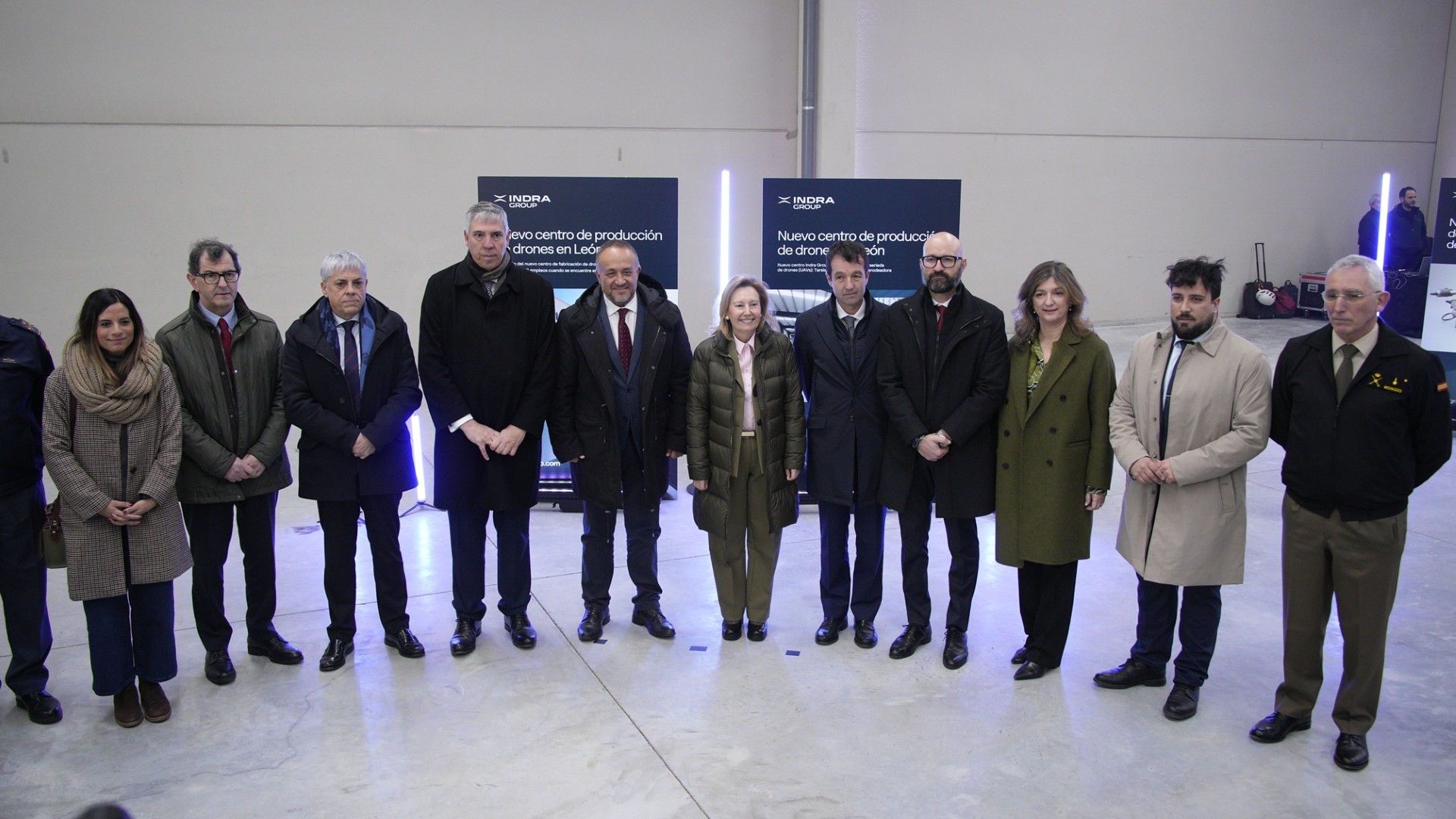
The Secretary of State for Defence, Amparo Valcarce, learned about the multinational’s plans in the province during a meeting with Indra Group’s Executive Chairman, Ángel Escribano, and the Group’s CEO, José Vicente de los Mozos

Indra Group will build in León the main and most advanced factory of multipurpose unmanned aerial vehicles (UAVs) and loitering munition, as part of its industrial growth strategy and expansion of its national footprint to respond to the Special Modernization Programs.

During a meeting held at the future facilities of this factory in León, Indra Group’s Executive Chairman, Ángel Escribano, and the Group’s CEO, José Vicente de los Mozos, explained the multinational’s growth plans to the Secretary of State for Defence, Amparo Valcarce.

In addition to the new drone factory—planned to be built in the Villadangos del Páramo industrial area (León) and intended to create 200 new jobs—Indra plans to strengthen engineering capabilities in the region by hiring another 150 engineers.

In her speech, the Secretary of State for Defence, Amparo Valcarce, stated: "I would like to thank Indra for its commitment and strategic vision in this project to provide the innovative solutions that Spain’s security and defence require. But above all, I want to thank them for their confidence in León and to reiterate our commitment to modern, technologically advanced Armed Forces and to a defence industry with a vocation for international leadership."

Indra Group’s Executive Chairman, Ángel Escribano, stated that this “new drone production center in León, where advanced unmanned aerial vehicle systems will be manufactured, contributes to ensuring national technological sovereignty in this field and meeting the current needs of the Armed Forces.”

With an investment of nearly 12 million euros, Indra will concentrate in the new facilities its production capabilities for unmanned aerial vehicles, including the tactical TARSIS system and its VALERO multipurpose aerial vehicle weapon system, as well as the loitering munition from the new company created with EDGE for the manufacturing of defense systems within the framework of the European Defense Programs. The factory will include specific assembly lines by drone type.

The goal is to begin manufacturing and integrating Class 1 UAS weighing under 150 kg, both for defense and civilian applications, as well as serial production of munition-equipped drones starting in 2027.

Indra will collaborate with León Airport and with the Army’s Air Systems Acquisition Group (GROSA) to establish a center for testing and validation of new systems, including both drones and counter-drone solutions.

With this initiative, Indra continues advancing its industrial response to the Special Modernization Programs (PEM) and strengthens its Indra Weapons & Ammunition division, focused on the development of unmanned vehicles, counter-drone systems, precision-guided systems, and directed-energy systems. It also contributes to securing national technological sovereignty in the drone domain and positioning León and the local industry for international opportunities, with Europe—where UAS are identified as a strategic solution—being one of the main markets.

To reinforce its capabilities in this field, Indra Group acquired in 2025 the company Aertec Defence & Aerial Systems, incorporating its TARSIS family of tactical systems into Indra’s offering, and recently acquired the unmanned system (UAS) technologies of Wake Engineering.

New engineers to strengthen capabilities

In addition to creating the new drone factory, Indra plans to expand the engineering capabilities of its current center in León. The company’s objective is to strengthen its capabilities in key areas such as cyberdefense, simulation, command and control and intelligence (C2I), software development, communications, unmanned aerial systems (UAS), counter-UAS systems, weapons and ammunition, and air traffic systems.

About Indra Group Indra Group (https://www.indragroup.com/) is the foremost Spanish multinational and one of the leading European companies that focus on defence and advanced digitalization. It stands at the forefront of the defence, space, air traffic management, mobility, and transformative technologies through Minsait, and it integrates its sovereign AI, cybersecurity and cyberdefence capabilities into IndraMind. Indra Group is paving the way to a more secure and better-connected future through innovative solutions, trusted relationships and the very best talent. Sustainability is an integral part of its strategy and culture in order to overcome current and future social and environmental challenges. At the close of the 2024 financial year, Indra Group posted revenues of €4.843 billion and had a local presence in 46 countries and business operations in over 140 countries.

This will build on the success of PULSE NOVA, the UAE based joint-venture establish to develop and manufacture next-generation

 Indra Group, a world leader in information technology, aerospace, defence and mobility systems, and EDGE Group, one of the world’s leading advanced technologies and defence groups, today signed a Memorandum of Understanding (MoU) to explore the possibility of expanding its successful joint venture PULSE NOVA to include advance electronic warfare (EW) capabilities and to enable PULSE NOVA to draw on the combined capabilities of Indra and EDGE, through SIGN4L, EDGE’s radar and electronic warfare entity, in support of a broader and more competitive portfolio. .

The MoU, signed in Dubai Airshow by EDGE Managing Director & CEO, Hamad Al Marar, and Angel Escribano, Executive Chairman of Indra, and Jose Vicente de los Mozos, CEO of Indra, will provide the parties with a framework within which they will explore the possibility of extending their successful current collaboration , through the Abu Dhabi-based company, to develop and manufacture next-generation radar systems in the UAE to potentially include advance electronic warfare (EW) capabilities within the portfolio of PULSE NOVA.

Ángel Escribano, Executive Chairman of Indra Group, said: “The extension would represent the determination of both companies to create a global market leader both in the field of advanced radar and electronic warfare technologies across multiple domains”.

José Vicente de los Mozos, CEO of Indra Group, stated: “The interest in extending the joint venture’s scope is the result of the excellent track of the current strategic partnership that woud bring together complementary capabilities, experience, and commercial reach to deliver worldclass solutions to our clients, reinforcing our positioning in the Middle East”.

Hamad Al Marar, Managing Director and CEO of EDGE Group, said: “We are building on a joint venture that has already delivered strong results in radar development. Electronic warfare demands deep expertise and an ecosystem that can move with purpose, and this collaboration

would bring both. By bridging the capabilities of Indra and EDGE, we could build a portfolio that serves regional and international customers and strengthens PULSA NOVA as a centre for advanced mission systems.”

The current collaboration is placing a strategic focus on the continued development of sophisticated technologies, innovation, and global market expansion by targeting untapped and fragmented non-NATO markets outside of the European Union where EDGE is bringing its commercial strength and technology building blocks, while Indra enhances PULSE NOVA by transferring technology, and contributing engineering, commercial, and manufacturing capabilities.


Featured

Most Read

We use cookies

We use cookies on our website. Some of them are essential for the operation of the site, while others help us to improve this site and the user experience (tracking cookies). You can decide for yourself whether you want to allow cookies or not. Please note that if you reject them, you may not be able to use all the functionalities of the site.