




A disruptive new business model and tools for the book publishing industry support the creation of interactive, immersive multisensory experiences leveraging prosumers
The term ‘prosumption’ has been around for more than four decades and the phenomenon even longer. However, digitalisation has put it in the spotlight and opened the door to new business models. Prominent examples can be found in the energy sector and online information fora.
In book publishing, prosumers engage with books by creating content associated with them such as reviews, fan art, or fanfiction. The latter refers to original writing about existing fictional characters with narratives that expand or reimagine published work and has exploded in recent years.
This engagement adds value to the original products through grassroots advertising and by augmenting prosumers’ enjoyment of them. The EU-funded Mobius project set out to leverage the power of prosumers in its new business model, the ‘Möbius Book Experience’, an immersive and interactive way to experience books.
The prosumer intelligence toolkit
Mobius’ prosumer intelligence toolkit for publishers is focused on prosumers of fanfiction belonging to fanfiction communities, a rich source of data and engagement. It is designed to help publishers better understand how global readers are relating to books, their characters and storylines.
According to project coordinator Rosa Araujo of Eurecat: “The toolkit applies digital methods from computational social science, complemented by user studies, to analyse and learn from the vast open online communities of readers and writers. This allows publishers to gain insight into readers’ habits, preferences and interactions with digital content.”
The ‘Möbius Book Experience’
Mobius provides four ways to enhance prosumer engagement with books. The ‘Möbius Book Creator’ enables prosumers to create immersive book experiences, combining text with audio reproduction and accessible via the ‘Möbius Player’. “The ‘Mobile Immersive Book Box’ is a portable room – an audiovisual space hosting an immersive art installation where users can experience the contents of a book. It includes the book’s soundtrack, specially composed to enhance the storytelling experience,” explains Araujo.
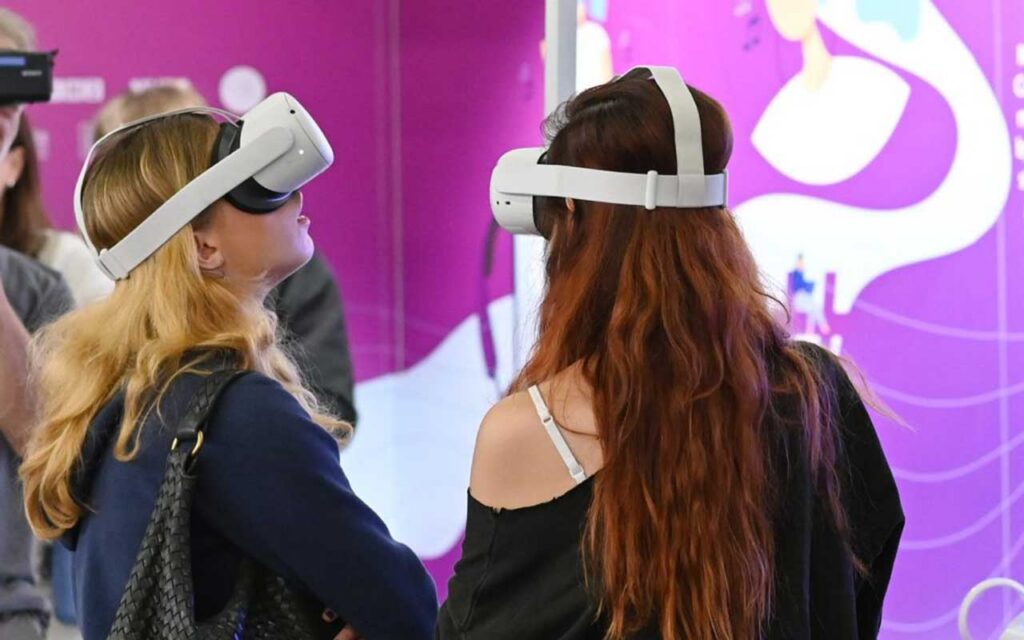
Prosumers can also enjoy books via a virtual reality (VR) experience, providing full 360-degree immersion without the Book Box. Finally, the ‘Möbius Immersive Book Art Installation’ combines digital animation, 2D and 3D characters, visual effects, 3D models, compositing and motion graphics, all arranged with music and special 3D spatial sound effects. It was created by Franz Fischnaller, media artist, and Rupert Huber, sound designer, and produced by Kunstkraftwerk Leipzig.
The future of publishing
“The Mobius project is a beacon for the future of publishing with immersive book experiences for all ages. Its unique blend of interactive exhibits and VR adventures allows participants to step into different worlds and explore new experiences, not only as individuals but as families or groups of friends,” says Araujo.
Furthermore, markets unforeseen at project start emerged from the user validation process. Those facing challenges with conventional books including people with attention deficit disorder, dyslexia or blindness benefited tremendously. Others found the Mobius audio player to be an excellent tool for people learning a new language.
Mobius intends to revitalise the European book publishing sector by remodelling traditional value chains and business models, ultimately leading to a more user-centric and user-driven publishing industry. And that will benefit not only the industry but also its prosumers.