




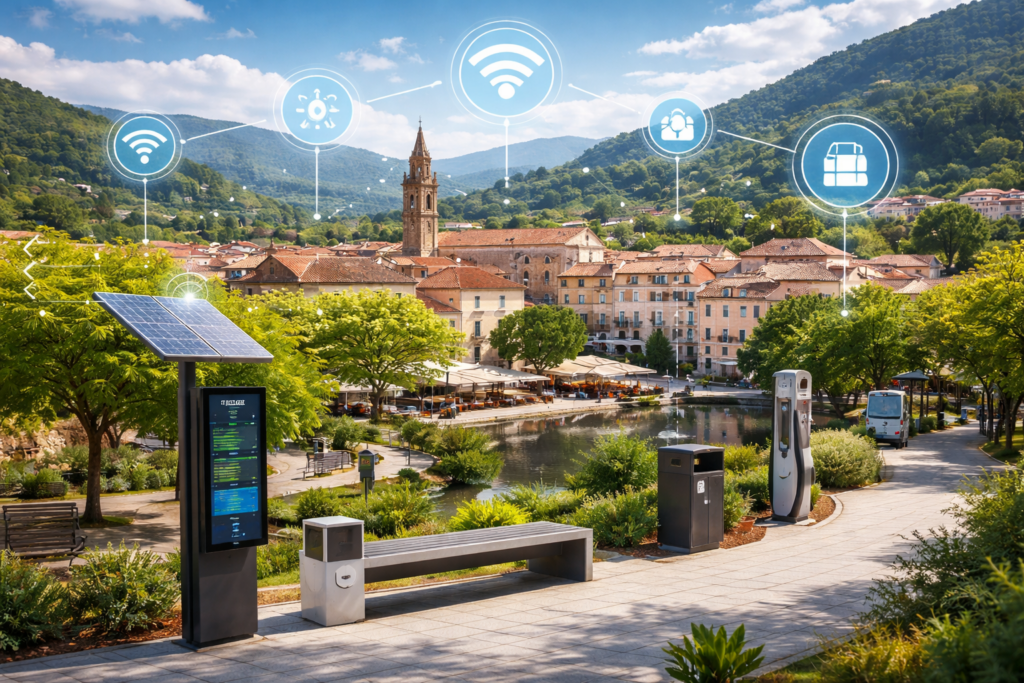
Efficiency, savings, population retention and quality of life: in smaller municipalities, technology is not modernity — it is survival
For years, the concept of the smart city has been associated with large capitals filled with sensors, control centers and spectacular technological deployments. However, where this transformation makes the deepest sense is in small cities.
A municipality of 10,000 or 20,000 inhabitants faces exactly the same challenges as a large metropolis: lighting, water, waste, mobility, social care and urban maintenance. The difference is that it has far fewer financial and human resources to manage them.
In this context, technology is not a luxury but an essential tool to sustain the municipal budget. Switching to LED lighting, installing remote water metering or placing sensors in waste containers can represent savings of 30% to 60% in key budget items.
But the most powerful argument is not economic — it is demographic. Small cities fight every day against depopulation and the ageing of their residents.
Being smart means offering public Wi-Fi, telemedicine, municipal coworking spaces, on-demand transport and digital procedures that avoid unnecessary travel. It means making the municipality livable in 2026 rather than in 1998.
This silent modernization is what allows towns to retain young people and attract new residents who can work remotely from anywhere.
Moreover, these cities have a strategic advantage: they are easier and cheaper to transform. Digitizing the entire lighting system or the entire water network is feasible with manageable budgets, and the impact is total rather than partial.
In a large capital, these projects are implemented district by district. In a small city, the change reaches the entire population.
Another key aspect is the improvement in care for older people, who represent a high percentage of residents. Tele-assistance systems, fall detection and medical reminders dramatically enhance quality of life.
Here, the smart city is not a technological label but a social safety net supported by digital tools.
That is why many of the success stories presented at international events such as the Smart City Expo World Congress or the Smart City Summit & Expo come from small municipalities where the impact is immediately visible.
These cities do not need a grand strategic plan or an innovation department. They simply need to apply digital common sense to everyday problems.
Starting with lighting, continuing with water, optimizing waste management and digitizing public administration already represents a revolution in the first year.
Well-applied technology makes it possible to do more with less and to provide better services at lower cost.
In short, a large city becomes smart to be more modern.
A small city becomes smart in order to keep existing.
Manuel Tarín Alonso
Owner & Founder
Image created with Artificial Intelligence