



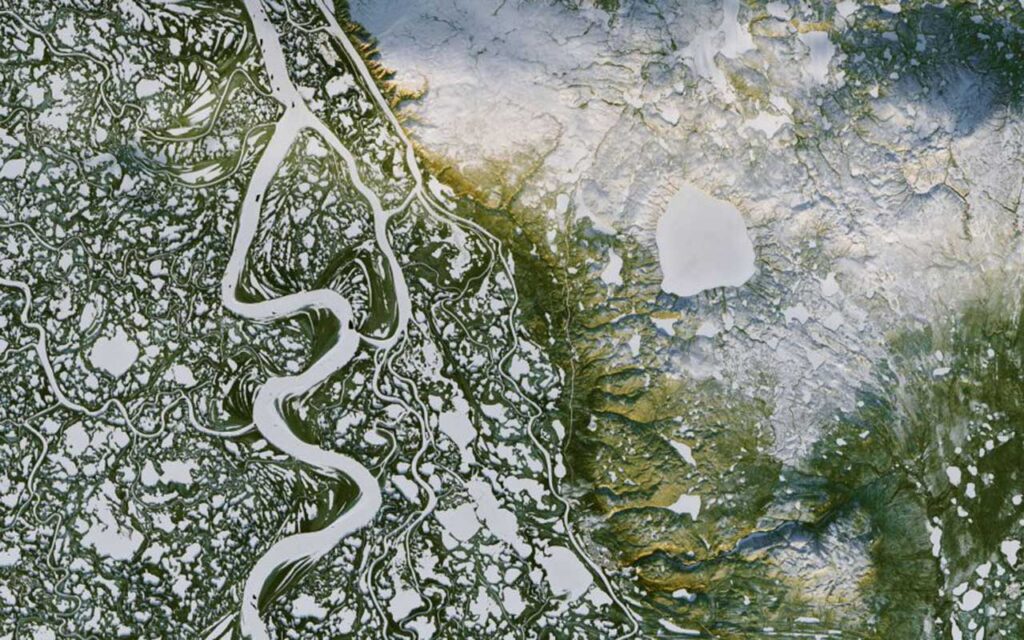
Researchers from the Department of Earth Sciences at the University of Oxford have shown that the weathering of rocks in the Canadian Arctic will accelerate with rising temperatures, triggering a positive feedback loop that will release more and more CO2 into the atmosphere
For sensitive regions such as the Arctic, where surface air temperatures are warming nearly four times faster than the global average, it is particularly crucial to understand the potential contribution of atmospheric CO2 from weathering. One pathway happens when certain minerals and rocks react with oxygen in the atmosphere, releasing CO2 via a series of chemical reactions. For instance, the weathering of sulfide minerals (e.g., ‘fool’s gold’) makes acid which causes CO2 to release from other rock minerals nearby.
In Arctic permafrost, these minerals are being exposed as the ground thaws due to rising temperatures, which could act as a positive feedback loop to accelerate climate change. Up to now, however, it has been largely unknown how this reaction will respond to temperature change and how much extra CO2 could be released.
In this new study, researchers used records of sulfate concentration and temperature from 23 sites across the Mackenzie River Basin, the largest river system in Canada, to examine the sensitivity of the weathering process to rising temperatures. Sulfate, like CO2, is a product of sulfide weathering, and can be used to trace how fast this process occurs.
The results demonstrated that across the catchment, sulfate concentrations rose rapidly with temperature. During the past 60 years (from 1960 to 2020), sulfide weathering saw an increase of 45% as temperatures increased by 2.3oC. This highlights that CO2 released by weathering could trigger a positive feedback loop that would accelerate warming in Arctic regions.
Using these past records from rivers, the researchers predicted that CO2 released from the Mackenzie River Basin could double to 3 billion kg/year by 2100 under a moderate emission scenario. This change would be equivalent to about half the total annual emissions from Canada’s domestic aviation sector for a typical year.
Not all parts of the river catchment responded in the same way. Weathering was much more sensitive to temperature in rocky mountainous areas, and those covered with permafrost. By modelling the process, the researchers revealed that sulfide weathering was accelerated further by processes which break rocks up as they freeze and shatter.
Conversely, areas covered with peatland showed lower increases in sulfide oxidation with warming, because the peat protects the bedrock from this process.
There are numerous similar environments across the Arctic where the combination of rock types, high proportions of exposed bedrock, and vast areas of permanently frozen ground create conditions where warming will result in rapid increases in sulfide weathering. As a result, it is extremely likely that this effect is not restricted to the Mackenzie River Basin.
According to the researchers, the study highlights the value of considering sulfide weathering in large scale emission models, which are extremely useful for making predictions of climate change.
The study ‘Temperature sensitivity of the mineral permafrost feedback at the continental scale’ has been published in Science Advances.