



The “one-of-a-kind” phenomenon was observed in ordinary graphite.
Magnets and superconductors go together like oil and water — or so scientists have thought. But a new finding by MIT physicists is challenging this century-old assumption.
In a paper published in Nature, the physicists report the discovery of a “chiral superconductor” — a material that conducts electricity without resistance, and also, paradoxically, is intrinsically magnetic. Even more surprising: they observed this in graphite, the common material used in pencil lead.
Graphite is made from stacked layers of graphene — atom-thin sheets of carbon atoms. Occasionally, these layers form a staircase-like “rhombohedral” configuration. When four or five graphene layers are stacked this way, they exhibit unusual electronic properties not found in standard graphite.
MIT physicists isolated microscopic flakes of rhombohedral graphene and cooled them to 300 millikelvins. The result: superconductivity, with electrical current flowing without resistance. But even more unexpectedly, the material showed magnetic-like switching between two superconducting states when exposed to an external magnetic field — a behavior not seen in other superconductors.
“The general lore is that superconductors do not like magnetic fields,” says Long Ju, assistant professor of physics at MIT. “But this is the first observation of a superconductor that behaves as a magnet — a truly bizarre and unique result.”
Ju and colleagues, including researchers from MIT, Florida State University, the University of Basel, and Japan’s National Institute for Materials Science, conducted extensive tests on the phenomenon, confirming consistent results across six separate samples.
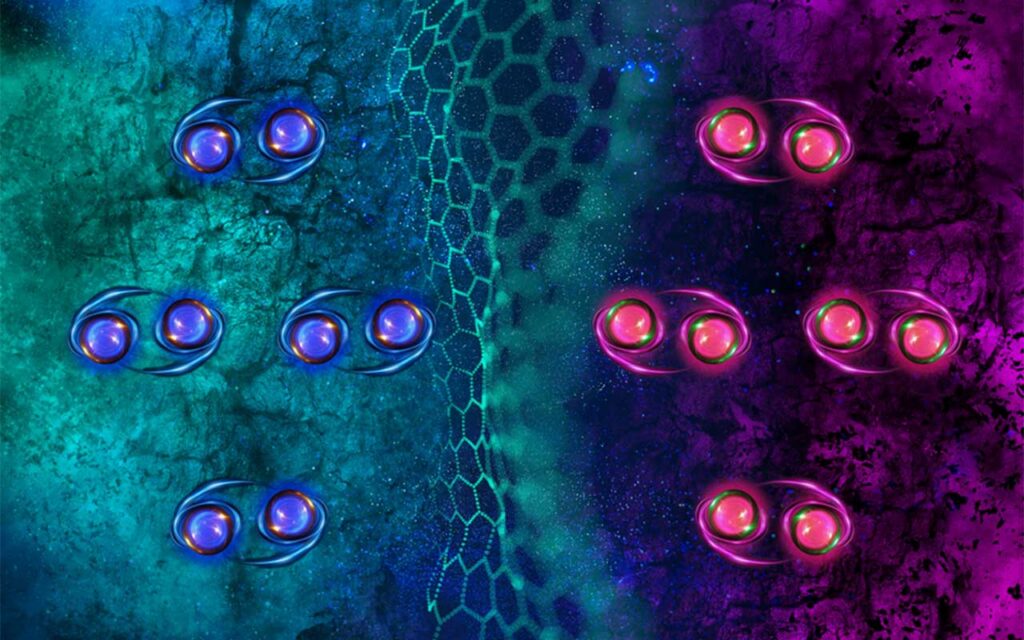
Typically, superconductors repel magnetic fields via the Meissner effect. But in this case, the rhombohedral graphene structure appears to allow electrons to pair and spin in coordinated ways, forming “chiral” Cooper pairs that carry intrinsic momentum — and thus, internal magnetism.
“This material seems to switch between two superconducting states, like a magnet flipping direction,” says Zach Hadjri, a student in the group. “It’s a superconductor that also acts like a magnet — which doesn’t make any sense by conventional physics!”
The researchers believe this unique behavior stems from the electrons’ orbital motion, aligning within a single “valley” or momentum state, and forming chiral superconductivity — a potential foundation for topological superconductors and robust quantum computing.
“Everything we’ve discovered in this material has been completely unexpected,” says Zhengguang Lu, now assistant professor at Florida State University. “But the simplicity of the system gives us hope that we can fully understand the underlying physics.”
“It is truly remarkable that such an exotic chiral superconductor emerges from such simple ingredients,” concludes MIT professor Liang Fu. “Superconductivity in rhombohedral graphene will surely have a lot to offer.”
The research conducted at MIT was supported by the U.S. Department of Energy and a MathWorks Fellowship.
Source: Jennifer Chu | MIT News