




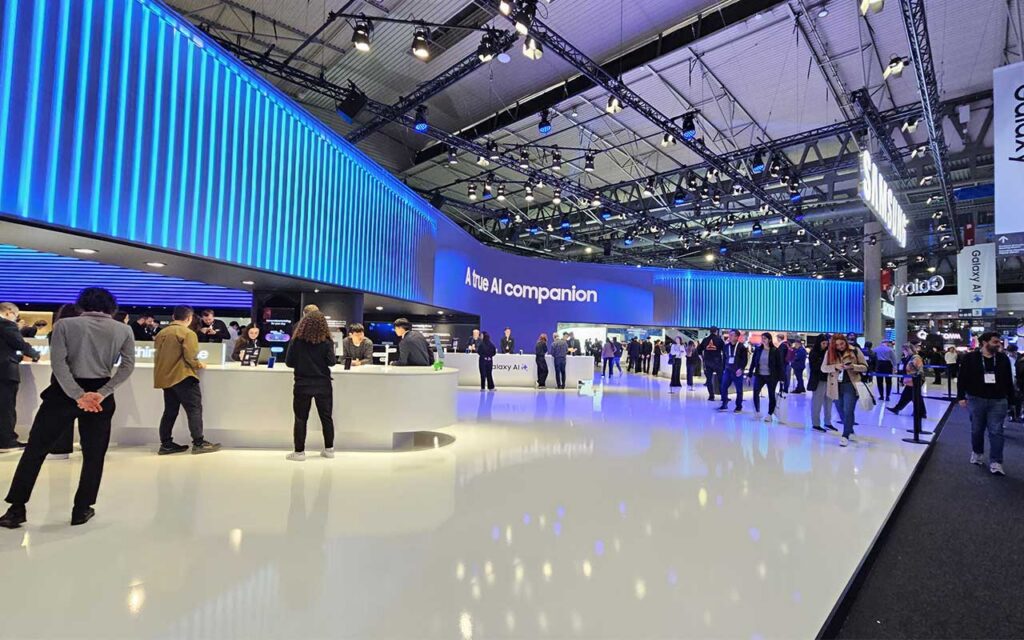
From AI-powered smartphones to self-healing networks, MWC25 showcased how artificial intelligence is no longer just a feature—it’s the foundation of the next era of technology.
MWC25 proved that AI is no longer just a buzzword—it’s the driving force behind innovation across industries. While smartphones grabbed headlines, AI stole the spotlight, shaping everything from telecom infrastructure to cybersecurity, autonomous systems, and digital ethics.
AI as the new digital backbone
AI is now the core of modern digital infrastructure. Leading operators showcased AI-powered network orchestration, where machine learning predicts demand surges, reduces latency, and automates network management. Telecoms are embedding AI into cloud-native RAN, network slicing, and self-healing systems, making connectivity more dynamic and efficient.
AI-driven cybersecurity is also on the rise, with telecom providers deploying AI-based fraud detection and digital identity protection. Customer service is getting an AI makeover, too, as virtual assistants streamline interactions and cut operational costs.
AI-optimized chips: the brains behind the revolution
AI isn’t just about software—it’s now embedded into hardware. Microsoft and Qualcomm unveiled Snapdragon X Elite-powered AI PCs, boasting on-device AI processing for real-time optimizations, privacy, and power efficiency. Processing in memory (PIM) modules promise faster, AI-optimized data handling, pushing the limits of performance.
At Qualcomm’s booth, Copilot+ showcased AI integration across multiple laptop brands, highlighting how AI-powered PCs are reshaping personal computing.
AI agents: the real reason to upgrade your phone
The only reason to buy a phone in 2025? AI.
Samsung’s Galaxy S25 Ultra introduced Galaxy AI, enabling real-time Call Assist translations, Chat Assist, and Photo Assist generative editing. Honor’s AI Agent took things further, reading on-screen content autonomously without APIs, making it a truly independent digital assistant. Android’s partner showcase demonstrated how different manufacturers are embedding AI agents, creating a seamless, AI-enhanced ecosystem.
AI-driven network enhancements
While AI is transforming network optimization, Deutsche Telekom and Google Cloud are taking it a step further with Agentic AI. At MWC25, they introduced a network AI agent, built on Gemini 2.0 in Vertex AI, designed to make Radio Access Network (RAN) operations truly autonomous.
The RAN Guardian AI agent, tested by Deutsche Telekom, analyzes network behavior, detects anomalies, and applies self-healing actions to improve reliability, efficiency, and customer experience. Unlike traditional automation, this AI system continuously learns and adapts, moving toward fully autonomous telecom networks.
AI and drones: intelligent aerial solutions
Drones at MWC25 were more than just flying cameras—they showcased how AI and telecom networks are merging to enable real-world automation. At its booth, Telefónica presented Open Gateway 5G Drones, an AI-powered fleet management solution designed to optimize surveillance, emergency response, critical infrastructure monitoring, and logistics.
What makes this possible? GSMA Open Gateway, a global framework of standardized APIs, allows businesses to integrate AI-powered drone operations seamlessly across industries. With real-time 5G connectivity, automated flight optimization, and compliance with airspace regulations, drones are becoming more autonomous, efficient, and secure.
This is AI in action: real-time data processing, predictive analytics, and automation, transforming drones from simple aerial devices into intelligent operational tools.
AI, security, and ethics: the battle for trust in a digital world
As AI-powered services expand, so do cybersecurity threats. At MWC25, AI was showcased not just as a tool for efficiency but as a critical defense mechanism against digital fraud, cybercrime, and emerging quantum-powered risks.
AI as the frontline defense
Cybercriminals are already weaponizing AI, but companies are responding with AI-driven security solutions. SK Telecom’s ScamVanguard exhibit demonstrated how AI can detect fraud in real-time, analyzing scam messages, caller ID spoofing, and phishing attempts before they reach users. As digital threats grow more sophisticated, AI is evolving into the first line of defense, learning patterns and blocking cyberattacks before they cause damage.
Responsible AI: ensuring transparency and fairness
Beyond security, discussions at MWC25 emphasized the growing need for ethical AI development. Transparency, fairness, and accountability were major themes, with experts stressing that AI must be explainable and aligned with human values to build trust and prevent bias-driven decision-making. Companies are under increasing pressure to embed responsible AI principles directly into their systems rather than addressing concerns after deployment.
Quantum threats and AI-powered encryption
Cybersecurity is also facing a major shift with the rise of quantum computing, which threatens to break traditional encryption methods. Telefónica’s Quantum-Safe Networks exhibit showcased how AI-driven encryption and quantum key distribution (QKD) are being developed to protect critical infrastructure and digital communications from future quantum-based cyberattacks. AI-enhanced cryptographic models are already being explored to anticipate security challenges before they emerge.
As AI continues to reshape digital interactions, its role in security, ethics, and quantum resilience will be just as crucial as its impact on innovation. The challenge ahead? Ensuring AI remains a force for protection—not exploitation.
The AI takeover is here
MWC25 cemented AI as the driving force behind next-gen technology. Whether in phones, networks, security, or hardware, AI isn’t an upgrade—it’s the new foundation. The future is not just about better devices, but smarter, AI-powered experiences that will define the next era of technology.