



Fragments of a rare Merlin manuscript from c. 1300 have been discovered and digitised in a ground-breaking three-year project at Cambridge University Library
A fragile 13th century manuscript fragment, hidden in plain sight as the binding of a 16th-century archival register, has been discovered in Cambridge and revealed to contain rare medieval stories of Merlin and King Arthur.
The manuscript, first discovered at Cambridge University Library in 2019, has now been identified as part of the Suite Vulgate du Merlin, a French-language sequel to the legend of King Arthur. The story was part of the Lancelot-Grail cycle, a medieval best seller but few now remain.
There are less than 40 surviving manuscripts of the Suite Vulgate du Merlin, with each one unique since they were individually handwritten by medieval scribes. This latest discovery has been identified as having been written between 1275 and 1315.
The manuscript had survived the centuries after being recycled and repurposed in the 1500s as the cover for a property record from Huntingfield Manor in Suffolk, owned by the Vanneck family of Heveningham.
It meant the remarkable discovery was folded, torn, and even stitched into the binding of the book – making it almost impossible for Cambridge experts to access it, read it, or confirm its origins.
What followed the discovery has been a ground-breaking collaborative project, showcasing the work of the University Library’s Cultural Heritage Imaging Laboratory (CHIL) and combining historical scholarship with cutting-edge digital techniques, to unlock the manuscript’s long-held secrets – without damaging the unique document.
As every manuscript of the period was copied by hand, it means each one is distinctive and reflects the variations introduced by medieval scribes.
This one is believed to belong to the short version of the Vulgate Merlin, and small errors—such as the mistaken use of the name “Dorilas” instead of “Dodalis”— will help Dr Fabry-Tehranchi and her colleague Nathalie Koble (ENS Paris), to trace its lineage among surviving manuscripts.
The way the manuscript has been carefully executed, with decorated initials in red and blue, gave further clues to its origins and helped indicate that it was produced between the end of the 13th and the beginning of the 14th century.
The text is written in Old French, the language of the court and aristocracy in medieval England following the Norman Conquest and this particular fragment belongs to the genre of Arthurian romances which were intended for a noble audience, including women.
Innovative digitization techniques
The discovery set off an extensive conservation and research project, supported by the University Library with funding from Cambridge Digital Humanities.
The fragment’s condition posed a significant challenge. It was fragile, with tears and folds that made it difficult to handle. Traditional methods of conservation might have involved physically removing the binding to unfold the fragment, but this risked causing irreparable damage.
Instead, the team decided to preserve the fragment in situ, keeping it as an example of 16th-century archival binding practices while using cutting-edge technology to virtually unfold and digitise it.
Computed Tomography (CT) scanning
Conducted with equipment and expertise from the University’s Zoology department, the team used a powerful X-ray scanner—typically used for scanning fossils or skeletons—to virtually penetrate the layers of parchment and uncover hidden structures in the binding.
It provided a 3D model of the fragment and its binding and allows researchers to examine the structure of the binding without physically dismantling it. The scan revealed how the fragment had been stitched into the cover, providing insights into 16th-century archival binding techniques.
A CT scanner relies on the difference in density of the material. In this case both materials were the same density. The pages were stitched using thin strips of the same or similar parchment. The team spotted enough gap between the pages and the stitching to record that separation.
3D modelling
Industrial scanning techniques created highly detailed virtual models of the fragment, allowing researchers to study its creases, stitching, and folds in remarkable detail.
Virtual unfolding
The fragment’s text was not in a straightforward sequence; parts of it were hidden under folds or stitched into the binding.
Using mirrors, prisms, magnets, and other tools, the team at CHIL carefully photographed each section of the fragment. The hundreds of resulting images were then painstakingly reassembled digitally, much like a jigsaw, to create a coherent image of the text.
By manipulating the digital images, the team could simulate what the document might look like if it were physically opened.
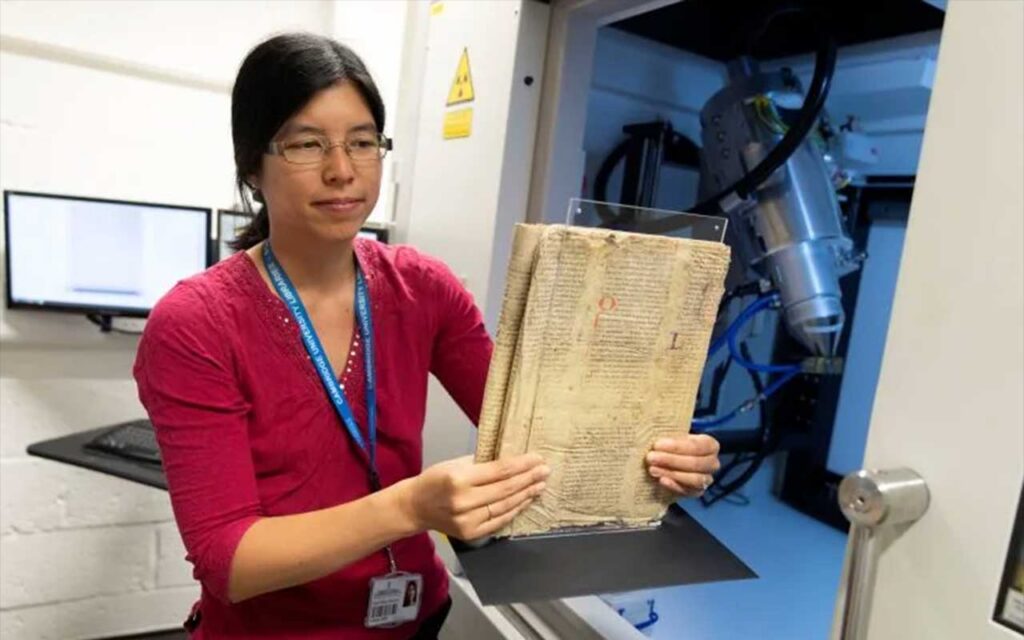
Photo: Dr Irène Fabry-Tehranchi holding the rare manuscript before inserting it into the Micro CT scanner in the Department of Zoology