


Antony Ondiwa Okundi
Department of Urban & Regional Planning, University of Nairobi. [email protected]
ABSTRACT
Universities have been hailed as generators of knowledge-based economies. However, in Nairobi City, the proliferated increase of campuses and infrastructural unpreparedness of the Central Business District has ignited a myriad of frictions. This paper focuses on the social, economic, infrastructural and environmental implications of the satellite campuses and the most appropriate panacea to arrest the induced roller coaster of space contestations. It also adopts a case study approach to illuminate the attraction factors and impacts of campuses and provide an entry point for empirical decision making and solution prescription. This paper also presents a silver bullet approach in ameliorating the place-based tensions in Nairobi Central Business District by designating campus districts, developing Convenient, Contextual, Cohesive, Ecological and Integrated Campus district models, campus and building prototype. The proposed spatial framework advocates for efficient and sustainable midwifery of the roles of campus development in African cities.
1. INTRODUCTION
In the 21st Century, universities have amassed the substantial recognition of being stimulators of a knowledge economy. Their spatial location in cities or urban landscapes have stimulated enormous place-based developments in terms of innovations, employment creations, real estate investments, voracious purchasing power, etc. In Kenya, for instance, regions, cities and urban environments have experienced a unique campus development status. Their economies have been flanked with a blossoming sprout of satellite campuses jostling for space and influence. Undoubtedly, current space contestations with other land use are solely attributed to the lack of anticipation of their contemporary influence and significance. Nairobi City Center is an exemplary illustration of the phenomena, where the zoning ordinance did not favor the location of universities and yet campus developments have been accelerating subject to kind admittance by the market forces. This paper seeks to contribute to knowledge about the various impacts of campuses and the attraction factors to African cities and urban centers and how we can midwife its proclaimed economic, social, environmental and infrastructural potentials in the face of their sprout in already developed cities. The structure of the paper answers the questions of (i) what is the spatial location of university satellites and neighbouring land uses? (ii) What are the attraction factors of Satellite universities to a CBD? (iii) What are the impacts of establishing satellite universities within a CBD? (iv) What planning panaceas can be employed to guide the future establishment of sustainable satellite universities?
1.1 Major facets of a knowledge economy
According to Neuman (2013), the concept of the campus was christened by an occurrence of universities forging functional and symbiotic relationships and links with different spatial locations. The early universities became an exclusive self-contained knowledge community, fortified by a permanent spatial syntax within cities or urban landscapes (Muthesius, 2000). After World War II, Campus designs were gradually dissolved into the immediate urban fabric. The chronological evolution of campuses from exclusive intellectual hives into cities within a city was profoundly perpetuated by the dynamics of intellectual activities, social and cultural perceptions and architectural designs (Kurtulus & Griffiths, 2017).
In contemporary times, campuses have risen to be talent economy giants, inoculating a creativity milieu into the genetic codes of cities and initiating a diversity of expertise, specializations, face-to-face interactions, vibrant social and spatial networks (Landry, 2008). Cities have since been scaffolded by helical bolsters of energy, society and economics, however, the quest for sustainability has paved way for the fourth juggernaut of a knowledge-based economy; creativity, (Hillier, 2016).The vitality of a knowledge-based economy is therefore hinged on the triple helix; spheres of universities, industries and governments ‘guilding’ to materialize an innovation hub (Etzkowitz, 2008).
1.2 impacts and role of universities in cities/urban landscape
Urban universities have since demonstrated their potential as powerhouses of knowledge and wisdom, museums of intellectual property, birthplaces of revolutions in science and technology (Dober, 2000). Undoubtedly, they have spiced up the urban economy by magnetizing incentives, knowledge-based industries, sieving and radiating human and intellectual capital (Beaverstock et al., 2000 and Parkinson, et al., 2006).Most importantly their transformation eminence has been made visible in their diverse functions as dispensaries of culture, aesthetics, morality and infallible defibrillators of economic and infrastructural landscapes of cities (Perry & Wiewel, 2015).The quest to establish the impacts and relationships forged between urban universities and cities engineered the classification of their roles as drivers of economic growth, revolutionary engines of human capital, nodes in a nexus network and cities within a city (Curvelo Magdaniel, 2013). Curvelo Magdaniel (2018), further examines the innovation stimuli elicited by campus development in the urban spheres. She successfully distills out the instrumental avenues that campuses ignite innovation and revitalization of cities; Innovation spaces, functional diversity, innovative climate and interminable flows of incentives.
Nevertheless, two interrelated models of “standalone” and “high-technology engagement” are inevitable (Benneworth et al., 2010). In the former, globalization influences the university to diversify their space consumption patterns while the latter is sustained by acute partnerships with the local authorities to establish shared quintessential structures such as innovation parks, which would revamp their intellectual and territorial competitiveness. They also point out that the “standalone” model exhibits spatial manifestations of universities in urban areas with abbreviated or subordinate clout from the immediate local authority while the ‘High-technology engagement’ model is based on the regulatory instruments sanctioned by the responsible local authority to elevate their local competitiveness. The intermeshing of the two models is therefore primal for the realization of ‘University-city complex model’ (Ngoa & Trinha, 2016).
1.3 Challenges and problems confronting campuses.
Privatization and exogenous pressure have perpetuated the operation of universities as social, political and institutional enclaves. Inevitably, campuses have been plunged into the grim hole of academic exacerbation and sterility (Furedi, 2005). According to Barber et al, (2013), campuses have had to grapple with the looming mismatches and disconnects between the university, society and economy, visible by the avalanche of unemployment rates youths and graduates. This is attributed to the increased appetite to climb the university ranking system to enjoy the adequacy of research funding and adept researchers. And hence, their recommendation for a ‘pluri-versity’ rather than just a ‘university’ which catalyzes the realization of university missions, needs and visions to accommodate the constructs and designs in arresting the contemporary economic and social issues.
Universities’ role in engineering location-based development has succumbed to the unprecedented conundrum of intense regional competition among affiliated institutions and preferential exclusive engagements with international partners and institutions. As exhibited in East London-Buffalo City, South Africa, Intense regional competitions among universities have blurred the connections and exchanges among local universities and hence an abbreviated commitment to regional development and transformation and stifling of academic autonomy and freedom (Bank & Sibanda, 2018).
Lesley Wilson in the ‘University and the City’ expatiate on the contemporary bottlenecks aggravating university autonomy. She believes that this is attributed to the endless pressures from financial crises, international collaborations and mobility muzzling how research funding is awarded, gaps in the management, leadership, technologies and specialization and accountability burden from governments and other relevant stakeholders (Goethe University, 2015).
The sprout of satellite campuses in cities to bolster the knowledge-based economy has brought along certain ‘university-city pickles’. As in the case of Nairobi city, the proliferation of campus developments has exhibited university-city phenomena flogged with the waves and tides of environmental pollution, social insecurity, street infrastructural mismatches, building structural mismatches, incompatible districts and institutional negligence. The market forces being the major spatial provider for the satellite campuses have also perpetuated their haphazard location patterns and installed the spirit of ‘enclavism’ (cf. Okundi, 2018a).
1.4 Panaceas of how we can do it better.
As indicated by an economist Jennifer Blanke (2015) at the World Economic Forum, the plausible antidotes to plummeting economic climates are talent, vibrant institutional frameworks and viable partnerships between public and private sectors. She insists that sustainable territorial economies can be buttressed by academic innovations. For instance, campuses that have mushroomed in blighted neighbourhoods have demonstrated the hell-bent potential of social, cultural, economic and infrastructural transformation (ICIC & CEOs-for-Cities, 2002).By engaging knowledge-based stakeholders into the economic chain, the competitiveness of urban areas and cities and regional economy have substantial been induced. Some of the ingenious models proposed to leverage the impact of universities include but not limited to Triple helix model, quadrangle helix model and University-City complex model.
Etzkowitz (2008) proposal to materialize colossal innovations in a knowledge-based economy is a triple helix model of industries, universities and governments. However, this model is not cognizable of the community that are the significant stakeholders of the city. Goddard and Valence (2013) believe that universities can be welded into cities frameworks to form a ‘civic university’ model that invigorates territorial growth and development. The model widens the impact loci of universities from economic and political spheres to social, cultural, infrastructural and integrated dimensions of the domicile city or urban center. It is an exemplary attempt to advance the triple helix model to a quadrangle helix model that conspicuously incorporates the society and its socio-cultural pillars. The inclusion of social innovations into the model arrests any vulnerability to ‘enclavism’. Perceptively, the quest for integration and coherence in cities hosting universities inspired the birth of the University-City model. It accrues its strength from science, economic growth, social and civic engagements among diverse stakeholders to instrumentally mitigate the intricate city problems.
Accordingly, the model amalgamates the concepts of an urban university and metropolitan university. The former registers an interplay between urban-oriented science and community involvements in the urban sphere while the latter champions the clout of community engagements in the intellectual discoveries by universities and advancement of the quality of life exemplified in Vietnam (Ngoa & Trinha, 2016).
Hajrasouliha (2015) illustrates a formidable recipe to a comprehensive campus master plan by deriving four conceptual approaches of campuses i.e. convenient campus, contextual campus, ecological campus and cohesive campus. The concepts are a reclassification of the principles of a comprehensive educational campus; ‘walkability, a sense of community, livability and safety, environmental sustainability, landscaping, university-city relationships, memory and avant- garde, nature and art, learning environment and partnerships’ (Calvo-Sotelo, 2010).
The Convenient concept attempts to transcend the traditional function of campus and establishes social, economic, institutional and environmental waves of opportunity to the users.
Hajrasouliha summarizes a convenient campus as a hub that ignites and facilitates sociability, workability, livability and fosters studentship. The Contextual campus thrives in a corroborative relationship function of both the government and private developers materializes a blend between the socio-economic elements of the campus with the physical fabric hence socio- economic synergy with the community, city and private developers. The Ecological campus is derived from the morphology of the landscape and attempts to cultivate the deliverables of environmental sustainability. In the Cohesive Campus, Hajrasouliha emphasizes on the physical or structural purpose of Campuses to demonstrate art and grandeur, modernity and ascribe the identity of the target campus (Hajrasouliha, 2015). The seamless integration of campus master plans into the CBDs or cities genetic code may not be enough. It must be backed by financial, sustainable and legislative flexibility to aptly midwife the roles and contributions of campuses to the domicile territory.
2. METHODOLOGY & STUDY AREA
The research study exploits a case study approach in examining the attraction factors, historical evolution and impacts of satellite campuses in CBDs. Cluster, stratified and purposive sampling was harnessed in tapping relevant information from sample frame i.e. campus students(128), campus administrators/directors(8), neighbouring land user(34), Nairobi City County (NCC) and Commission of University Education (CUE). Apart from field survey, other spatial data were sourced from USGS, Japan International Cooperation Agency (JICA) and Survey of Kenya. The study area is the Nairobi CBD, situated within the administrative confines of Nairobi Central ward, Starehe Sub-county and Nairobi City County. The CBD covers approximately 123.8Ha and hosts 21 satellite campuses.
3. RESULTS
- Attraction factors
The Nairobi CBD economy was initially being serviced by the University of Nairobi geographically located at its north. However, due to the evolutionary life of its economic sphere and high demand for educational advancement from the working class, satellite campuses have been enamoured to capitalize on the churned substantial Gross Domestic Product. Satellite campus sprout in the CBD transcends the extramural complimenting function to the University of Nairobi and mitigates not only the geographical disadvantages of knowledge seekers from other parent universities situated away from the City center but also accelerates accessibility and ameliorates distance decay from the various bus termini in the CBD (Kazungu, 2018).The field survey (2018) revealed that the prevailing factors that influenced knowledge seekers to patronize the satellite campuses in the CBD include educational services and packages offered at the respective institutions (34%), convenience of engaging in other activities in the CBD (19%), quality of the campus infrastructure (18%), no campus in various residential neighbourhoods (15%), proximity to their place of work(11%), proximity to the place of residence offered (2%), affordable educational services (0.5%) and provide quality services (0.5%),(Okundi,2018a).
3.2 History of campus emergence in the Nairobi CBD.
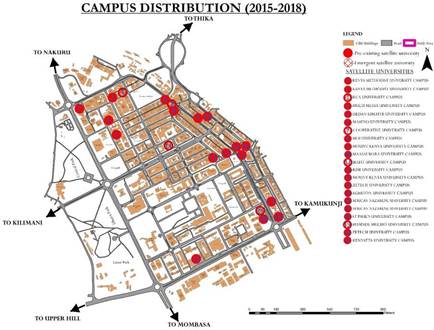
The CBD opened its doors to satellite campuses as early as in the year 2005 and hence their assessment was in three phases i.e. 2005-2009, 2010-2014 and 2015-2018.In the first phase (2005- 2009), seven satellite campuses had set up in the CBD i.e. Moi University Campus (2005), KEMU & KEMU Hub Campuses(2006), MKU Campuses(2009), Maseno University (2009) and Kenyatta University Campus(2009). During the second phase (2010-2014), an extra ten satellite university campuses were also exhibited in the CBD i.e. St. Paul’s University Campus (2010), Egerton University Campus (2011), Dedan Kimathi University Campus (2011), Africa Nazarene University campuses(2011 & 2012),Multi-media University Campus(2013),Kisii University Campus(2013), Maasai Mara University Campus (2013) and Zetech University Campuses (2014).In the last phase (2015-2018),four extra satellite campuses were spatially established in the CBD i.e. JKUAT University Campus (2015), Cooperative University Campus (2016), KCA University Campus (2016) and Masinde Muliro University Campus (2015).
3.3 Impacts
- Social Impacts
- Benefits of proximity to public spaces: The CBD hosts an appreciable number of recreational parks such as aesthetic green corridors, Jeevanjee Gardens, Hilton Park, Sunken Park, August 7th Memorial Park, Central Park and Uhuru Park. Their availability reduces the burden of provision by the satellite campuses and promotes inter-university interactions, intercultural sensitivity, and social
- Social enclave: The conversion of sections of commercial storey buildings to host university function have yielded to the social exclusion of its infrastructural and social amenities such as libraries and multipurpose halls. These facilities are only readily available to the consumer student population with abbreviated access and sense of ownership by the
- Campus community services: The field survey revealed that the satellite campuses were immensely assiduous to community outreach and engagements enshrined in their Cooperate Social Responsibility (CSR) policy. A majority (36%) of the satellite campuses informed that they partook in inter-university football They also indicated that their students and staff had been commissioned to engage in voluntary works (29%), charity visits to children’s homes (29%).Some also informed that they were visiting the sick at the hospitals e.g. Kenyatta National Hospital (7%).These have not only imparted social skills to the students but also induced intercultural sensitivity and city- community complex.
- Infringe of serenity and privacy: Since the satellite campuses magnetize a wave of customers to the recipient neighbourhood, there exist a dread of damage and loss of property in case of student strikes and demonstrations as indicated by (15%) of the neighbouring land users. Office-based buildings had their stakeholders (27%) raise concerns about the invasion of privacy by the huge traffic of students populating some of the shared facilities such as corridors, staircases, receptions, etc. This has therefore retarded the customer frequency to the office buildings hosting satellite campuses because they are associated with deterioration of building
- Campus milieu: The provision of space by market forces has plunged a majority of the satellite campuses in compromising districts and proximity to incompatible land uses such as bars, casinos and brothels. The students (15%) expressed their concerns about the disturbances and distractions from the uncongenial land uses while others (8%) indicated about their roller coaster of insecurity, social evils and turmoil, especially along Moi Avenue and Tom Mboya Street transect. Such streets register considerable congestions of pedestrians, passengers, street vendors, preachers, casual entertainments.
3.3.2 Economic Impacts
- Magnets of human labour: Satellite campus operations in the CBD have created employment opportunities with their magnitude varying in the floor space area they occupy. Some of the human labour enchanted by the satellite campuses including but not limited to; academic staff, administrators library administrators, campus bus drivers, secretaries, Accessories contactors, culinary personnel, security personnel, sanitary personnel, For instance, Kenya Methodist University Campus (KeMU) registered 120 academic staffs, 80 other staff members, 20 security personnel and 16 sanitary personnel.
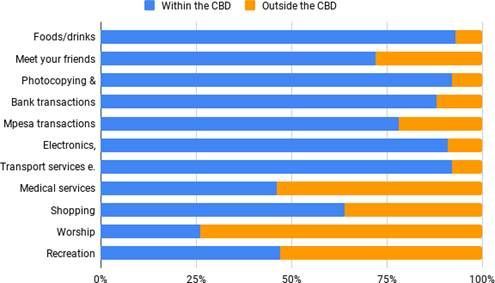
- Purchases and economic spin-offs: Formidable student and campus purchases were exhibited more in the Nairobi CBD than outside the CBD. These included; purchases in stationery, food/drinks, photocopying & printing services, electronic appliances & gadgets, meeting of friends, transport services, bank transactions, and Mpesa services. Contrarily, the source of medical services, spiritual nourishment, and recreational activities were primarily sourced outside the confines of the
- Economic revitalization: The neighbouring land use respondents (47%) indicated that they recorded an appreciable increase in sales of goods and services subject to the sprout of a satellite campus in their neighbourhoods. Appreciation of the role of satellite campuses as magnets of customers, unprecedented service providers and agglomerations by recipient neighbourhoods registered 35%, 13% and 9%
- Agglomeration economies: Most of the neighbouring land use operators (44%) related to the satellite campuses as triggers of colossal traffic of customers to their Relationships were also forged through sharing of building space (20%), parking space (13%), source of employees (13%) and partnerships in a community development project (6%).
- Accelerated economic development: Satellite campus choice of location in the CBD have implied a boom in economic demand. Unprecedented service providers have since stormed the campus neighbourhoods to maximize on the voracious demand. Some of the emergent entrepreneurial service providers such as Banks, Restaurants, Barbershops, Stationery shops, Electronic shops, Photocopying & printing shops, Supermarkets, Mpesa stalls, Restaurants, Hotels, Corner shops, cinema/movie halls, churches, gymnasiums, boutiques, shoe selling
- Rise in property rates: Building landlords in the CBD found it lucrative to host satellite campuses as opposed to several commercial tenants because of the handsome of money they mint on a quarterly basis. Permitting satellite campuses into the buildings have economically inconvenienced other tenants due to an upsurge of service charge caused by the exorbitant cost of maintaining the infrastructural elements such as lifts, water, electricity, and Some (12.5%) of the neighbouring land use operators raised their concerns about the rise of property prices and pointed out that they succumbed to a sharp increase in office rents from an average subscription of Ksh.(35-40) to an average of Ksh.50 per square foot (exclusive of service charge) and fluctuations annually.
- Shortage of good office space: Offices and Small and Medium Enterprises (SMEs) occupy an average space of (10-100 square meters) compared to a satellite campus that commands a voracious floor space of (500-10,000 square meters) which is an equivalence of three or more floors or even half of an average tower building in the Offices have therefore been grudgingly evicted and substituted by satellite campuses. Consequently, good office spaces are registering an increasing demand against diminishing supply coupled with skyrocketing rental prices.
3.3.3 Infrastructural Impacts
- Urban renewal: The preliminary requirements for approval and accreditation of satellite campus for occupancy in the CBD buildings are refurbishment guidelines. Floor space areas must, therefore, be modified to satisfy the demands of structural safety, fire safety preparedness, and public health. Satellite campuses in the acquisition of floor spaces installed interior designs and external designs that improve the building’s aesthetics and beauty.
- Parking issues: Satellite campuses have posed a substantial parking demand in the CBD.80% of them provided parking provisions for their academic staff while 20% could spatially afford parking spaces for students and visitors. Change of use of sections of buildings to serve university functions induced a mismatch between the parking needs of the satellite campuses and the available parking
- Infrastructural demand: Emergence of satellite campuses have imposed infrastructural implications on the CBD which is attributed to the huge traffic generated. Some of the deficiencies pointed up by the neighbouring land use operators include street markings and pedestrian crossing lanes(21%), parking spaces (12%), street furniture (12%), waste receptacles (12%), street maintenance (11%),green corridors (10%) road signage (1%), hotels (1%), shylocks (1%), and open spaces (1%).
- Structural implications: The demands for the consumer population in buildings hosting the satellite campuses have become inflated such that there is structural strain experienced on lifts, sanitary utilities, electricity, and water For instance, the field survey revealed that in all the sampled satellite campuses the lift systems were either functionless or faulty.
- Frictions with land use planning: The zoning ordinance of the CBD permits only civic and commercial functions. However, due to the economic dynamics, agitation for a knowledge-based economy prompted the provision of space by the market forces. This has therefore resulted in a haphazard location of satellite campuses in the CBD and consequent conflicts with responsible authorities i.e. City planners and
3.3.4 Environmental Impacts
- Air pollution: Twelve satellite campuses are situated along Moi Avenue and Tom Mboya Street which are concentrated with bus termini. Vehicular emissions from traffic jams and activities of bus termini pose a detrimental effect on the campus operations. This was also indicated by 6% of students whose student experience were curtailed by air pollution.
- Noise pollution: A majority (12) of the satellite campuses were located in environmental settings compromised by noise disturbances. Some of the major source of noise pollution revealed by the students included bus termini (38%), bar (31%), night clubs (20%), street vendors and preachers (4%), public demonstrations (2%), markets (1%) and casinos (0.5%).54.3% and 6% of students experienced medium and high level of noise disturbance (Okundi,2018a).
4. DISCUSSION
- Situational discussion
The current land use landscape of Nairobi CBD is legitimized by the zoning ordinance of 1960 that christened it as a hub of commercial and civic functions. Being the City center and the heart of the nation, economic evolution and dynamics have ignited enormous rippling and multiplier currents not only within regional confines but also to the economic pockets of the nation. For resilience and relevance in the contemporary economic climate, the CBD has magnetized satellite campuses to act as its engines of a knowledge-based economy. However, the provision of spatial space by the market forces, have plunged satellite campuses haphazardly into incompatible districts such as bars, brothels, bus termini. Accordingly, their increased sprout along major transport and commercial corridors have invigorated congestions, privacy invasions and related inconveniencies to take its toll.
Structural malfunctions of buildings in the CBD have also become inevitable. The built forms of the CBD were structurally designed and programmed to sustain average traffic in offices, commercial and civic points. Change of use of office and commercial buildings to accommodate university functions without any structural adjustments has stifled the sustainable capacitance of building utilities such as water provision, sewerage reticulation networks, electricity connectivity, sanitary facilities, and access lifts, elevators and staircases to host the huge traffic.
Diversity is an inextricable character of a blossoming economy in the Nairobi. However, certain commercial districts are incongruous to the wellbeing and optimal operation of satellite campuses. The haphazard location of satellite campuses proximity to incompatible land uses such as bars, brothels, casinos and bus termini, have not only enkindled their vulnerability but also conflagrated their campus milieu. Moreover, vehicular and pedestrian conflicts along major transport corridors such as Moi Avenue and Tom Mboya Street have exacerbated the functionality and user experience of the satellite campuses.
The infrastructural capacitance of the various streets in the CBD are unprepared to the huge traffic and colossal consumers attracted by the satellite campuses. Most of the streets are without adequate provisions of pedestrian crossing lanes, street traffic lights, street markings, street signage, bollards, stormwater and surface runoff catchment drains, street furniture and street planting. This has therefore elicited interminable user conflicts and retarded the permeability and accessibility of the old and those with physical disabilities.
It is worth noting that satellite campuses and the CBD have forged an economic synergy that has progressively minted a knowledge-based economy. Manifestations are evident in the agglomeration economies of sharing of costs, customers, parking spaces and infrastructural facilities. The satellite campuses have also responded positively by remitting advanced technology, expertise and extramural services to the Nairobi CBD. Additionally, their high purchasing power yield to bountiful harvest for the host districts.
Campuses have earned their role as hotbeds of science and technology, employment creators, real estate investors, incubators of companies and voracious consumer of goods and services (ICIC & CEOs-for-Cities, 2002). This can be summed up into the economic, social, infrastructural and environmental transformation power of Campuses. Nevertheless, only the economic sphere has been clinically exploited with an abbreviated mentality towards its other transformative power. Therefore, the satellite campuses have inadvertently subscribed to the ‘villain of enclavism’.
The botched distribution of satellite campuses within the Nairobi implies weak implementation forces by the responsible authorities. In spite of an existing policy and design framework governing the satellite campuses, little or nothing profound has been realized in the quest for creating an enabling environment for sustainable campus districts. The Nairobi CBD has hence, registered a continued burgeon in compromising districts or neighbourhoods that are detrimental to the optimal performance and vitality of satellite campuses.
4.2 Pragmatic discussion
Based on the premise and informed by the prescriptions of literature review, this paper endeavoured to plan and design university districts in the Nairobi CBD. The approach adopted was to first identify and designate campus districts and provide a spatial framework that would sustain its optimal performance and a synergetic blend with the CBD. Out of the five designated campus district, one was selected, designed and planned for and used as a prototype for the rest.
clusters. These clusters were then considered for designation as campus districts. Network synergies were then identified. Some of the feasible synergies include pedestrianization, green street planting, bicycle lanes, emergency lanes, etc.
One of the designated Campus districts was chosen and used as a prototype to demonstrate how best to plan and design for a Campus district appropriate for a commuter catchment population. The selected Campus district was the one at the northern segment of the CBD and adjacent to the University of Nairobi, Main Campus (Labelled 1).
The formulation and design of the alternative campus districts borrowed from the aforementioned policy and design-oriented approaches and the reviewed literature on the concept of a campus. The actual alternative designs amplified the cohesive model, contextual model and ecological model which envelops the planning and design principles (Hajrasouliha, 2015). Accordingly, the preferred model of a campus district was a harmonization of the socio- economic, cultural, infrastructural, environmental and institutional qualities of the proposed campus district and hence an Integrated Campus District Model. This model is an overlay of cohesive, contextual, ecological and convenient models.
Assuming an eighteen-floor building that hosts a satellite campus, mixed-use designation for its floors will be as follows:
- Ground floor and the first floor: Are to be occupied by commercial activities such as electronic shops, cyber, restaurants, Mpesa shops, Barbershops, gymnasiums, etc. These commercial functions will be prime in supplementing Campus
- The Second floor to the seventh floor: Are to serve office functions e.g. private firms, consultancies and agencies. This segment will act as a buffer zone between the campus functions and the commercial
- The Eighth floor to the eighteenth floor: Are to support all the quintessential space needs of a satellite campus in the CBD. These include library section, lecture rooms, administrative offices, Academic staff offices, auditoriums, multi-purpose halls and recreational spaces. Subdivision of space should adhere to the CUE’s guidelines and regulations.
- Tower rooftops: Rooftops of buildings in the Nairobi CBD were found to be To maximize the use of rooftops of tower buildings hosting satellite campuses, redesign of rooftops should be considered. Building rooftops are therefore to be utilized as ;(i) Campus restaurants ii. Recreational spaces e.g. view parks, meet up points (iii) Spaces to lay communication masts and boosters e.g. Safaricom, Airtel or Telkom masts etc. (iv) Spaces to practice urban agriculture. (v)Spaces to host green energy generators e.g. solar panels. (vi) Spaces of water harvesting and colossal water storage tanks.
The recommended space use syntax above demands a sustainable redesign of the structural elements such as lifts, elevators, staircases, electrical and water reticulation systems. Minor or major structural adjustments to correspond to the carrying capacity of the target buildings. Moreover, because of the huge traffic patronizing the buildings, regular maintenance is significantly quintessential.
5. CONCLUSION
The location of campuses in cities or urban areas triggers a snowballing impact if properly baked in social, economic, cultural, infrastructural and environmental dimensions. In Kenya, the sprout of satellite campuses in CBDs has continued to suffer neglect by the responsible institutional bodies. This ineptitude vacuum has stimulated the market forces to sprout more campuses defiant to the stipulated policy and legal requirements and haphazardly distribute campuses in compromising districts. Also witnessed in other cities such as Mombasa, Kisumu, Nakuru, etc., ‘laissez-faire’ mentality and the profit-oriented market forces have blinded the realization of the role of universities in cities. It has also detracted the campus operations into enclaves of social, cultural, infrastructural and environmental transformations. The role of universities can only be midwifed if planning and design are exploited. Accordingly, this entails the designation of campus districts and the unveiling of synergy with the CBD. This paper presents comprehensive design models significant in moulding a spatial framework that establishes social, economic, infrastructural and institutional interplay pivotal to fuel a knowledge-based economy.
References
Bank, L., & Sibanda, F. (2018). Universities as city-builders: The city-campus development opportunity in East London–Buffalo City, South Africa. . Development Southern Africa, pp.706.
Barber, M. D. (2013). The avalanche is coming: Higher education and the revolution ahead. London: Institute for Public Policy Research.
Beaverstock, J. N. (2000). World city networks: A new meta-geography. Annals of the Association of American Geographers, pp.123-124.
Benneworth, P., Charles, D., & Madanipour, A. (2010). Building Localized Interactions Between Universities and Cities Through University Spatial Development. European Planning Studies Vol. 18, pp.1612.
Blanke, J. (2015). CNN Interview on the Global Competitiveness Report 2014-2015 at World Economic Forum on 4 October 2015.
Calvo-Sotelo, P. C. (2010). The concept of “Educational Campus” and its application in Spanish universities. pg 2-3.
Dameri, R. P. (2017). Smart City Implementation: Creating Economic and Public Value in Innovative Urban Systems. Switzerland: Springer International .
Dober, R. P. (2000). Campus landscape: Functions,forms,feature. New York: John Wiley.
Etzkowitz, H. (2008). The Triple Helix:University-Industry-Government Innovation in Action. New York : Routledge.
Furedi, F. (2005). Where have All the intellectuals gone. London.: Continuum. Goddard, J., & Vallance, P. (2013). The university and the city. Abingdon: Routledge. Goethe University. (2015). The University and the City. Frankurt: Goethe University.
Hajrasouliha, A. H. (2015). The Morphology of the “Well-Designed Campus: Campus design for a sustainable and livable learning environment.Doctorate thesis. Utah.: University of Utah
,department of City and Metropolitan Planning. .
Hillier, B. (2016). The Fourth Sustainability, Creativity: Statistical Associations and Credible Mechanisms. In: Portugali J., Stolk E. (eds) Complexity, Cognition, Urban Planning and Design. Springer Proceedings in Complexity. (pp. pp. 75-92). Switzerland: Springer.
ICIC & CEOs-for-Cities. (2002). Leveraging colleges and universities for urban economic revitalization: An Action Agenda. Boston: Initiative for a Competitive Inner City.
Kazungu, R. (2018, October 17). Attraction factors of satellite campuses in the Nairobi CBD. (A. O. Okundi, Interviewer)
Kurtulus, I., & Griffiths, S. (2017). Kurtulus, I., & Griffiths, S. (2017). The effect of University Campuses on the spatial cultures of two mid-sized towns: A Comparative Study of Nottingham, UK and Eskisehir, Turkey. 11th Space Syntax Symposium (p. p.p 76.18). Lisbon: SSS Lisbon.
Landry, C. (2008). The Creative City: A Toolkit for Urban Innovators (2nd Edition). Bournes Green: Comedia.
Magdaniel, F. C. (2013). The university campus and its urban development in the context of the knowledge economy. p.p 3-4.
Magdaniel, F. C., Jonge, H. D., & Heijer, A. D. (2018). Campus development as catalyst for innovation. Journal of Corporate Real Estate, Vol. 20 Issue: 2,, pp. 87-88. https://doi.org/10.1108/JCRE-07- 2016-0025.
Muthesius, S. (2000). The postwar university: Utopianist campus and college. New Haven: Yale University Press.
Neuman, D. J. (2013). Building Type Basics for College and University Facilities. New Jersey: John Wiley & Sons.
Ngoa, L. M., & Trinha, T. A. (2016). A University-City Complex, a Model for Sustainable Development:a Case Study in Vietnam. Sustainable Development of Civil, Urban and Transportation Engineering Conference. Vietnam: Elsevier Ltd.
Okundi, A. O. (2018a). Impacts of satellite universities on a Central Business District: A Case of Nairobi CBD, Unpublished thesis. Nairobi: University of Nairobi,Department of Urban & Regional Planning.
Okundi, A. O. (2018b.). Planning for Satellite Campuses in the Nairobi CBD,Unpublished thesis. Nairobi: University of Nairobi,department of Urban & Regional Planning.
Parkinson, M., Champion, T., Evans, R., Simmie, J., I.Turok, Crookston, . . . P.Wood. (2006). State of the English cities: A research study: Vol. 1. Retrieved from https://www.liverpool.ac.uk/media/livacuk/publicpolicypractice/State,of,Cities,V1.pdf. Liverpool: University of Liverpool.
Perry, D. C., & Wiewel, W. (2015). The University as Urban Developer: Case Studies and Analysis. New York: Routledge.