



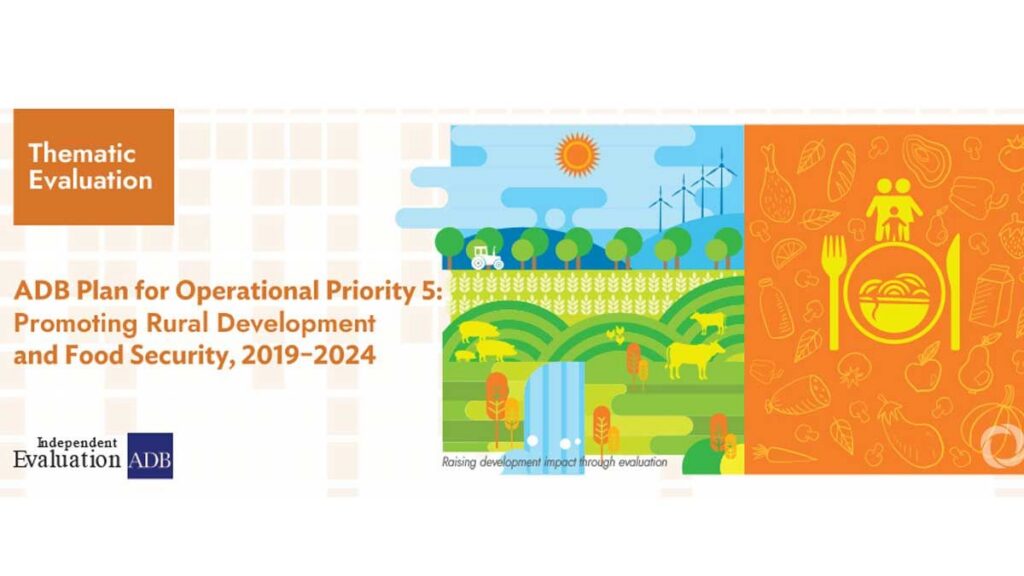
The Asian Development Bank (ADB) needs to prioritize building resilient and sustainable agrifood systems to achieve its objective of becoming a major contributor towards food security in the region, a report from ADB’s Independent Evaluation Department (IED) said
The report examines how well-positioned the Asian Development Bank (ADB) is to support rural development and food security under ADB’s operational plan and reflected in its country partnership strategies and portfolio. ADB has invested approximately $33 billion in rural development and food security during the evaluation period, 2017–2022.
“Identifying rural development and food security as an operational priority under ADB’s Strategy 2030 was appropriate given the needs of its developing member countries,” said IED Director General Emmanuel Jimenez. “However, the strategy could have provided clearer guidance on how specific objectives should be defined, how they are to be mapped, and how they are to be tracked by a robust and verifiable methodology across ADB’s sector teams.”
ADB has almost doubled its support for agriculture value chains, an approach that offers entry points across sectors for both sovereign and nonsovereign support, says the report. Building on examples of coherent support across sectors, improved performance in agriculture, increased focus on climate resilience, partnership with the private sector, and cooperation with development partners offer potential for better scaling up and widening impact.
“Scaling up and better integration of private sector investments into ADB’s wider support for rural development and food security, and stronger monitoring and reporting of results are needed,” said evaluation team leader Garrett Kilroy. “Also, the evaluation found that ADB’s efforts on food security focus mostly on agriculture production, commercialization, and resilience, with less attention to nutrition.”
More than half the world’s people affected by hunger are in Asia. In 2021, nearly 1.9 billion people in the region lacked healthy diets because of poverty and soaring food prices. Agrifood systems employ 40% of the workforce in Asia, placing rural development and food security as a central issues for the region. The evaluation further presents recommendations on how ADB can build on its experience to help ADB’s developing member countries achieve prosperous rural economies, reduce malnutrition, crowd in the private sector, and attain food security.