




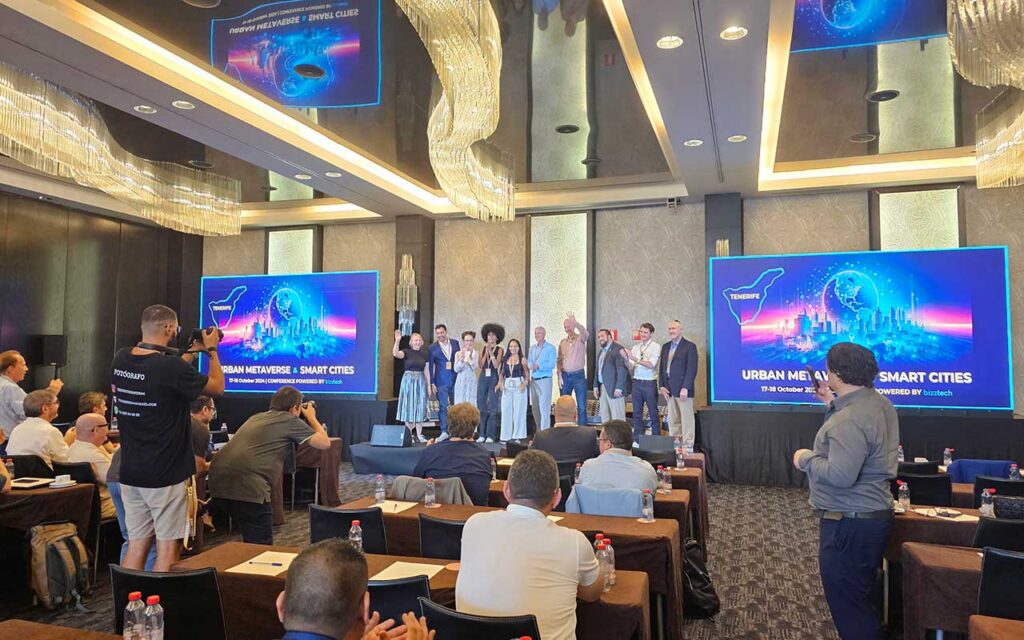
50+ international speakers debate the metaverse, digital twins, and energy consumption in Tenerife at the Urban Metaverse & Smart Cities event
Imagine waking up in a city that knows you. A city where the streets, buildings, and even the air you breathe are not just part of your surroundings—an invisible web of intelligence connects them. A city that adapts to your needs before you even realize them. This vision, one that seamlessly blends the physical with the digital, was at the heart of the Urban Metaverse & Smart Cities event, created by BizzTech and held in Tenerife. The event with more than 50 international speakers explored how cities can harness advanced technologies like artificial intelligence, digital twins, and the metaverse to create smarter, more sustainable urban spaces.
Experts, city planners, technologists, and policymakers converged to discuss how the fusion of virtual and physical realities could reshape urban life, making cities more adaptable, inclusive, and responsive to the needs of their citizens.
Cities as Living Networks: The Human Metaverse
At the core of this future is the concept of the Human Metaverse, an idea introduced by Raffaele Gareri, Co-Founder & CEO of Urban Futures. He asked the audience to rethink the role of cities in our lives. “The city you live in is not just a place,” Gareri explained, “it’s a living network that understands you.” In this vision, cities don’t just function as environments for people—they evolve into responsive ecosystems that anticipate and adapt to the needs of their inhabitants.
Gareri’s vision painted a world where technology is no longer an external tool but something that breathes with the city, reacting to the ebb and flow of daily life. “In this new world, we stop talking about technology as an add-on. It becomes part of the air we breathe,” he said. This seamless integration of technology into urban life would enable cities to become more human-centered, focusing on the well-being and daily experiences of their citizens.
The Metaverse: A Digital-Physical Fusion
But what exactly is the metaverse, and how does it shape the future of cities? The metaverse refers to a collective virtual shared space, often accessed through augmented reality (AR) and virtual reality (VR), where the digital and physical worlds merge. This space is an interactive environment where people use avatars to explore, design, and test urban solutions that are difficult to achieve in real life.
At the Urban Metaverse & Smart Cities Event in Tenerife, attendees were given a glimpse of this transformative potential by experiencing the Montgomery Civil Rights March in the metaverse. This immersive re-creation was developed by BizzTech, demonstrating how metaverse technology can foster global engagement, inclusivity, and education. Participants from around the world could walk alongside a digital re-creation of the historic route, engage with AI-powered characters, and learn about the pivotal moments of the civil rights movement.
As José Antonio Ondiviela Ph.D., Director of the Human-Centered Intelligent Cities Research Institute, explained, the metaverse can serve as a testing ground for new urban environments. “Why limit our imaginations to what’s possible here, when we can explore entire worlds in the metaverse?” he asked. Through digital twins—virtual replicas of cities—urban planners can model and test scenarios before building in the real world. These virtual models offer a risk-free space for experimentation, pushing the boundaries of innovation without physical limitations.
The Social Digital Twin: A New Layer of Urban Insight
A significant evolution of the digital twin concept was introduced through the Social Digital Twin, a central topic in Ondiviela’s talk. Expanding on the traditional digital twin, which primarily replicates physical infrastructure, the Social Digital Twin models and forecasts human behavior within cities. “Cities are not just physical structures; they are deeply intertwined with the movements, behaviors, and needs of their people,” Ondiviela explained. This technology enables cities to monitor and simulate how pedestrians move, how services are utilized, and how citizens interact with their surroundings based on real-time data.
By utilizing advanced sensing technologies, Social Digital Twins offer the ability to pre-verify decisions in the digital world before they are implemented in reality. “Before implementing measures in the real world, we can test their impact in a controlled digital environment, optimizing decisions before they are made,” Ondiviela emphasized. This technology enhances urban planning by anticipating social dynamics, thus reducing risks and costs.
Community Engagement: Designing Cities with Citizens in Mind
While technological advancements like digital twins and AI are critical to the future of cities, community engagement remains a fundamental aspect of urban development. As Professor Jen Lloyd of Griffith University pointed out during the event, “Communities need to have a voice in shaping their cities, not just at the beginning, but throughout the entire process.” This sentiment was echoed across discussions, emphasizing that technologies like the metaverse should serve as tools to bring citizens into the design and decision-making process. David W. Sime, a top voice in emerging technologies, reinforced this idea, stating that immersive platforms could enable broader public participation by making urban planning more accessible and interactive. The shared belief among the experts was clear: for smart cities to truly thrive, they must be co-created with the people who live in them.
The Power of Digital Twins: A New Age of Urban Planning
Taisha Fabricius, Technology Leader at the ESRI R&D Center in Zurich, took this concept further by exploring the powerful role of digital twins. She traced the technological history that led us here, from the invention of the telephone to the rise of the internet, explaining how each breakthrough reshaped cities. “The telephone laid the foundation for a more interconnected society, essential for the future growth of cities,” Fabricius noted, pointing to the advancements that paved the way for today’s smart cities.
Now, digital twins are at the forefront of urban development. “Our cities are becoming more dynamic and interactive,” Fabricius explained. “This technological fusion is not just about convenience—it enhances urban planning, making it more efficient and more inclusive.” Digital twins allow cities to simulate complex scenarios and respond to real-time data, creating living, breathing models of urban environments.
“When the system becomes truly autonomous, it has the ability to self-learn, to adapt, and to operate independently,” she said. This suggests a future where cities manage themselves, optimizing everything from traffic flows to energy consumption.
Energy and Accessibility: Tackling the Challenges of the Urban Metaverse
One of the key panels at the event, moderated by Joe Appleton, Smart Cities Director at BizzTech, delved into the pressing concerns of energy consumption and accessibility in the metaverse. The panel featured Philip Van Nedervelde, Founder of Ecoverse, and Michal Łakomski, Mayor’s Proxy for Smart City, City of Poznań, Poland.
Van Nedervelde emphasized the environmental impact of the metaverse, explaining how Ecoverse is leveraging eco-friendly blockchain networks like Flare to power the metaverse in a sustainable way. He noted, “We calculated that by moving just 2% of physical events to virtual or hybrid ones, we could reduce the event industry’s carbon footprint by the equivalent of planting 320 million trees.”
Łakomski addressed accessibility, sharing how Poznań is working to ensure that smart city technologies are inclusive, especially for older generations. He cited an example where the majority of early users of the city’s online waste management system were over 60, demonstrating how digital services can be embraced across all demographics. Van Nedervelde added that Ecoverse was designed to be accessible across a wide range of devices, ensuring that even a child in a remote village with only a smartphone could participate in virtual worlds like Virtual Moon.
Smart Cities as a Necessity for Survival
While the technological possibilities are exciting, the challenges facing cities today are more urgent than ever. Abdelhameed Mohamed, Head of the Smart City Department at the Engineering Consultants Group in Qatar, emphasized the critical role of sustainability. “Smart and sustainable cities are not a luxury,” he explained. “They are crucial for the future of humanity.”
Mohamed used a memorable analogy to describe the creation of smart cities: “We aim at the end to have a delicious and healthy meal.” City planners, like chefs, must combine various “ingredients” such as smart mobility, architecture, and technology to create cities that serve both people and the planet.
He also stressed the importance of digital twins in combating climate change. By tracking greenhouse gas emissions in real-time, these digital tools allow cities to take immediate action. “We can’t improve what we can’t measure,” Mohamed said, highlighting how technology can help cities meet their sustainability goals.
Merging Humanity and AI: A New Symbiosis
At the Urban Metaverse & Smart Cities event, a key topic was how AI and human needs will merge to transform the future of urban living. Experts discussed how artificial intelligence will not only assist in daily tasks but will also be seamlessly integrated into the fabric of cities, making them more responsive, adaptable, and personalized to the individual. This vision of AI blending with human experiences offers a new way to approach urban design and interaction.
Another important theme was the energy consumption of AI-driven solutions and digital infrastructure. Abdelhameed Mohamed highlighted the need for sustainable, AI-powered urban environments. As cities integrate more advanced technologies, ensuring they remain energy-efficient and environmentally conscious will be vital. Mohamed emphasized the role of digital twins in tracking real-time emissions and enabling cities to quickly respond to environmental challenges.
The potential for AI to contribute to sustainable urban ecosystems was reinforced by Dr. Jennifer Loy who pointed out that integrating AI with digital twins and smart infrastructure allows cities to become self-learning systems. These systems can adapt in real time, optimize resource usage, and make proactive decisions, making the future of cities not only smarter but also more sustainable.
Shaping the Future Together
Throughout the event, one theme emerged repeatedly: collaboration is key to shaping the cities of tomorrow. Whether through integrating digital twins with real-time data or using immersive technologies to bring residents into the planning process, the future of cities will depend on collective effort. Fabricius emphasized this point, saying, “We need to be able to shape these cities together.” Technologies like AR and VR allow citizens to engage with urban planning in unprecedented ways, helping to shape the environments in which they live.
Special Thanks
The success of the Urban Metaverse & Smart Cities event was a testament to the dedication of its organizers and participants. Special thanks go to Dirk Schmidt, Co-Founder & CEO, Rosi Vieira, Co-Founder & CMO, Jason Shuster, Co-Founder & COO, Barry Gillespie, Global Vice President of Strategic Partnerships, Francisco Fuenzalida, BDev Latam & Spain, and Joe Appleton, Smart Cities Director. Together, the BizzTech team worked seamlessly to bring the event to life, demonstrating exceptional collaboration and vision in creating an unforgettable experience.
The event’s panel discussions and speaker lineup were expertly coordinated by Joe Appleton, whose leadership in organizing and moderating the sessions ensured engaging and insightful conversations. Alongside Joe, Olga Dzieciątkowska, Innovation Manager at Huge Thing, who served as an outstanding MC and host, brought an extra layer of energy and professionalism to the event, guiding attendees through the program with enthusiasm and expertise. Their combined efforts were crucial in shaping the dialogues that explored the intersection of metaverse technology and smart city innovations.
We would also like to thank the panelists and keynote speakers whose expertise shaped the event, including (in alphabetical order):
- Carles Agusti i Hernandez, Sustainability & SDG Manager, WORSLEY, Spain
- Charbel Aoun, EMEA Lead, Smart Cities and Spaces, NVIDIA
- David W. Sime, CTO, Riiot Digital, UK
- Dr. Jennifer Loy, Digital Business Innovation, Griffith University, Australia
- Dr.-Ing. Steffen Braun, Deputy Director, Fraunhofer Institute IAO, Germany
- Edwin Acosta Ph.D., President of the Smart Cities Engineering Committee, Colegio de Ingenieros, Peru
- Esteve Mede, CEO & Founder, END TO END ENTERPRISE SOLUTIONS, USA
- Francis Ortiz, CEO, UBIKUA, Spain
- Henry Shterenberg, Chairman of the Investment Committee, Mayor’s Club of Ukraine
- Jorge Saraiva, CIO, Grupo Trés60, Portugal
- Juan José Martínez Díaz, Counselor of Innovation, Research, and Development, Tenerife Government & President, PCTT, Spain
- Louisa Barker, Senior Research Manager – Government Insights Europe, IDC, UK
- Michael Lake, President & CEO, Leading Cities, USA
- Nader Afzalan Ph.D., Visiting Professor, UC Berkeley & Founder/CEO, Triangle, USA
- Olaf-Gerd Gemein, Director of Business Development, GreenEarthX, Germany
- Omar Saúl Duarte Useche, Director, Investment Bank of Smart Cities, ANAP, Colombia
- Prof. Dr.-Ing. Vanessa Borkmann, Director of Research Department Urban Systems Engineering, Fraunhofer Institute IAO, Germany
- Sandra Baer, CEO, Personal Cities, USA
- Vitor Pereira, Co-founder, ZOOM GLOBAL SMART CITIES ASSOCIATION, Portugal
A Future Built on Collaboration and Innovation
The Urban Metaverse & Smart Cities event offered a glimpse into a world where AI, digital twins, and immersive technologies blend seamlessly with our daily lives. The metaverse, once seen as a concept from science fiction, is now becoming a space where cities are not only planned but experienced and tested in real time. This vision promises a future where cities are smarter, more sustainable, and deeply connected to the needs of their inhabitants.
While challenges such as energy consumption and data privacy remain, the tools to build this future are already within reach. It’s up to us to bring this exciting vision to life, together.
by Esther Fuldauer, The Smart City Journal