


With AI and linguistics, this professor is decoding how animals and humans communicate

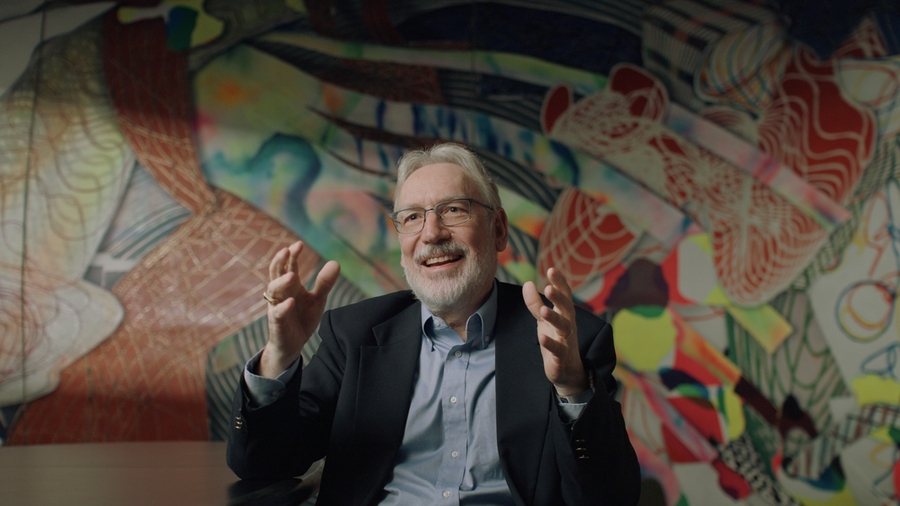
Watch a UC Berkeley linguistics professor explain his work in just 101 seconds.

When Gašper Beguš began studying linguistics, he spent his time deciphering ancient, largely dead languages. “Nobody cared about linguistics,” he says in this episode of 101 in 101, a series from UC Berkeley that challenges professors and other experts to distill the basics of their field of study into only 101 seconds.

But today, linguistics sits at the crossroads of numerous disciplines, including biology, law, and computer science. Colleagues from across academia are suddenly interested in leveraging what linguists have learned.

“The machine learning people really want to know how we do things,” says Beguš, an associate professor of linguistics at Berkeley. So do lawyers, biologists, and others.

And Beguš, for his part, wants to know how the machines learn. In his lab, he’s working with an artificial intelligence that has been built to listen and then mimic the sounds it hears, much like a human infant.

The artificial intelligence system might help shed light on how we learn our first words and construct our first sentences.

“There’s still so many unknowns about how we are able to learn language,” says Beguš.

Expanding Linguistics Beyond Humans

Beguš is also using AI in other novel ways. As he explains, linguistics has long only studied human language, but he and others are working to open up the field to other species. His lab is using AI to examine sounds made by jumping spiders, elephants, bees, and sperm whales.

“It’s really powerful to use linguistics as a tool to look inside these animals and see how they communicate, how their lives work,” says Beguš. “I think it’s a really exciting time because we’re opening up linguistics to these artificial models on one hand and then the animal kingdom on the other.”

Source: Sean Patrick Farrell (news.berkeley.edu)

With AI and linguistics, this professor is decoding how animals and humans communicate

With AI and linguistics, this professor is decoding how animals and humans communicate

Watch a UC Berkeley linguistics professor explain his work in just 101 seconds.

When Gašper Beguš began studying linguistics, he spent his time deciphering ancient, largely dead languages. “Nobody cared about linguistics,” he says in this episode of 101 in 101, a series from UC Berkeley that challenges professors and other experts to distill the basics of their field of study into only 101 seconds.

But today, linguistics sits at the crossroads of numerous disciplines, including biology, law, and computer science. Colleagues from across academia are suddenly interested in leveraging what linguists have learned.

“The machine learning people really want to know how we do things,” says Beguš, an associate professor of linguistics at Berkeley. So do lawyers, biologists, and others.

And Beguš, for his part, wants to know how the machines learn. In his lab, he’s working with an artificial intelligence that has been built to listen and then mimic the sounds it hears, much like a human infant.

The artificial intelligence system might help shed light on how we learn our first words and construct our first sentences.

“There’s still so many unknowns about how we are able to learn language,” says Beguš.

Expanding Linguistics Beyond Humans

Beguš is also using AI in other novel ways. As he explains, linguistics has long only studied human language, but he and others are working to open up the field to other species. His lab is using AI to examine sounds made by jumping spiders, elephants, bees, and sperm whales.

“It’s really powerful to use linguistics as a tool to look inside these animals and see how they communicate, how their lives work,” says Beguš. “I think it’s a really exciting time because we’re opening up linguistics to these artificial models on one hand and then the animal kingdom on the other.”

Source: Sean Patrick Farrell (news.berkeley.edu)


Most Read

We use cookies

We use cookies on our website. Some of them are essential for the operation of the site, while others help us to improve this site and the user experience (tracking cookies). You can decide for yourself whether you want to allow cookies or not. Please note that if you reject them, you may not be able to use all the functionalities of the site.