




The project was born from a doctoral thesis (Joan Simó), with the support of SandBox Urbano and Valencia Innovation Capital
Can technology transform citizens’ voices into tangible actions that improve urban environments? This is the question that drives CitizenBack, a pilot project born within the framework of a doctoral thesis at the Polytechnic University of Valencia and developed by engineer Joan Simó, with the support of the Urban Sandbox of Valencia and Valencia Innovation Capital.
The initiative stems from a well-documented reality: most mechanisms for citizen participation are slow and disconnected from day-to-day public service operations. In fact, according to the OECD report (2024), OECD Survey on Drivers of Trust in Public Institutions, only 30% of the population believes the system allows them to have a say in government decisions. Moreover, two out of three people feel that their opinions will not be considered in a public consultation, reinforcing a clear reality: there is a growing social demand for more direct forms of involvement in public policy.
This is why the UN-Habitat programme People-Centred Smart Cities stresses that the design of cities must begin by providing mechanisms that continuously listen and act upon the voices of their inhabitants, to avoid technological environments disconnected from social realities.
In this vein, CitizenBack aims to create tools that turn citizen opinions into concrete actions by public administrations. That is, if we collect public opinion in a structured, location-specific and continuous manner, and that information is automatically processed and analysed, then we can generate a new relationship between citizens and public institutions.
A city that listens in real-time
This governance model, based on citizen-generated data, can be applied across multiple areas: from street cleaning and infrastructure maintenance, public transport or cultural programming, to extending library hours, reinforcing social services in high-demand areas, managing street lighting, improving safety around schools, or even optimising tourism services and natural spaces during peak seasons. It is a first step towards a more agile, responsive and transparent administration. A new balance between the digital and the human.
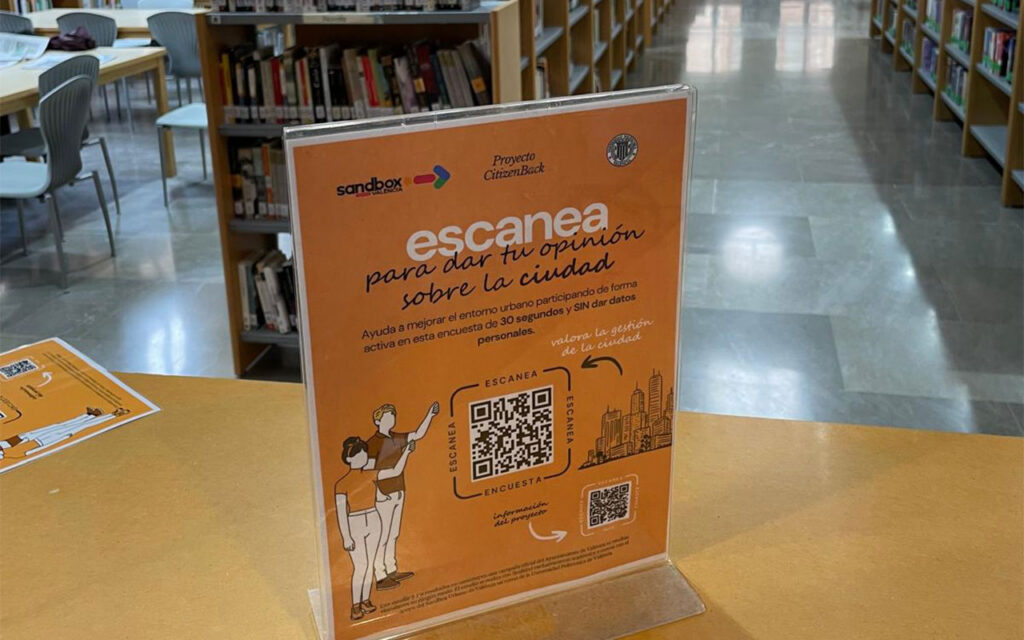
CitizenBack, through its digital platform, collects citizens’ opinions on public services in real-time. Through posters with QR codes placed in municipal spaces such as libraries or innovation centres, anyone can access a quick, anonymous survey to express their perception of the service received and, in doing so, contribute to a decision-making process that is more agile, approachable, and evidence-based.
All this information is processed automatically and displayed on dashboards with relevant data for municipal technical teams. In addition, thanks to Artificial Intelligence (AI), the tool helps identify patterns, trigger early alerts, and activate direct actions from the administration. It goes beyond the usual ‘citizen consultations or surveys’: it is a live pilot of how citizen participation can become an operational and strategic tool for urban management. For instance, if repeated requests for extended opening hours are detected across several libraries, the system can trigger an alert and refer the issue to facility managers, who will then have the information they need to make decisions.
The Urban Sandbox of Valencia: the city as a living lab
One of the main challenges behind this type of initiative is being able to validate it in real environments, as bureaucratic and administrative procedures are often highly complex.
This is where the Urban Sandbox of Valencia comes into play — a pioneering initiative at international level — that turns the city into a laboratory for testing technological solutions in controlled yet real-life conditions. This unique public policy allows tools like CitizenBack to be tested without having to wait through lengthy administrative procedures. In Valencia, urban innovation is purposefully accelerated.
Valencia has proven to be a fertile environment for such trials. The city is committed to combining technology, sustainability and participation, and the institutional support for the CitizenBack project reflects that commitment. As Valencia Innovation Capital points out, the best innovation is that which is tested in real-life settings, in contact with citizens’ daily lives, and through a quadruple-helix collaboration: private sector, academia, public institutions, and civil society.
A vision for the future
The challenge now is to scale and replicate the initiative. Data collection will expand to new spaces and services. The model will be opened to other interested cities. Above all, results will continue to be measured not only in terms of the number of responses but also in terms of the concrete actions taken based on people’s feedback.
At a time when many cities are looking for ways to engage more closely with their citizens and govern within complex and ever-changing contexts, projects like CitizenBack help pave the way towards real, agile and operational participation. Not as an end in itself, but as an effective means of improving the quality of urban life and strengthening public trust.
As Archon Fung, Professor of Citizenship and Democracy at the Harvard Kennedy School of Government, puts it, 21st-century democracies must design channels where citizens not only express opinions, but influence public action with speed, traceability and meaning, and this is precisely where CitizenBack comes in.
Author

Joan Simó Esteve. Engineer and researcher at the Polytechnic University of Valencia, expert in smart, sustainable and people-centred cities.
LinkedIn: www.linkedin.com/in/joansimó
Project information: https://urnova.my.canva.site/citizenback