



Dozens of faculty members at Stanford are working to transform the way the world grows, distributes, and consumes food, with research and scholarship spanning topics including sustainable food systems, food security, health equity, culture, and diet.
A bite of food is about more than calories. Food production involves energy, water, and other resources and is shaped by economics, policies, and international relations. What we eat affects our health, expresses our cultures, and shapes communities.
Feeding the world is an urgent challenge: In 2023, the United Nations reported that one in 11 people globally faced hunger, with 2.33 billion people facing moderate or severe food insecurity. These disparities in food access and malnutrition lead to a cascade of other problems.
Stanford’s history with food research stretches back to the founding grant’s mention of “the study of agriculture in all its branches.” From 1921 to 1996, the Stanford Food Research Institute, inspired by Herbert Hoover, led globally influential research on food systems.
Today, Stanford remains well-positioned to influence the way the world grows, distributes, eats, and thinks about food. Threads of food research and teaching run throughout the university, crossing disciplines and schools, including the work of dozens of faculty members. This is complemented by interdisciplinary and solution-focused efforts established to coordinate this work.
Interdisciplinary Research in Food Systems
“Interdisciplinary research can help us understand how each disciplinary contribution fits into the bigger picture of global food security. Through such collaboration, advances are also made on basic research questions within disciplines,” said Rosamond Naylor, professor of environmental social sciences in the Stanford Doerr School of Sustainability.
Adaptive Plants, Agriculture, and Aquaculture
Understanding plants is foundational to improving global food systems – and that means studying the building blocks of food from many angles.
For her part, Elizabeth Sattely, associate professor of chemical engineering in the School of Engineering, investigates plant chemistry and how plants transform CO2 and sunlight into molecules that benefit human health.
Similarly, David Lobell, professor of Earth system science, uses remote sensing to evaluate climate adaptation in agriculture.
The Human Element in Food Systems
People are at the heart of the food system as laborers, consumers, and decision-makers. Food is personal in terms of culture, health, and society.
Lisa Goldman Rosas, assistant professor in the Department of Epidemiology and Population Health at Stanford Medicine, leads the Food For Health Equity Lab, which partners with community food distributors to address food insecurity.
A New Era of Collaboration
Stanford’s interdisciplinary approach to food research brings together experts from multiple fields. The Stanford Food Institute unites students, faculty, and entrepreneurs to improve food access and sustainability.
Other initiatives, like the Food Futures program led by Sattely, focus on research that enables equitable, sustainable, and nutritious food solutions. “We can look at the world differently and draw upon the expertise that we have in business, engineering, sustainability, and policy to take a different approach,” said Ellen Kuhl, professor of mechanical engineering.
By valuing collaborative efforts, Stanford is developing innovative solutions to the world’s most pressing food challenges.
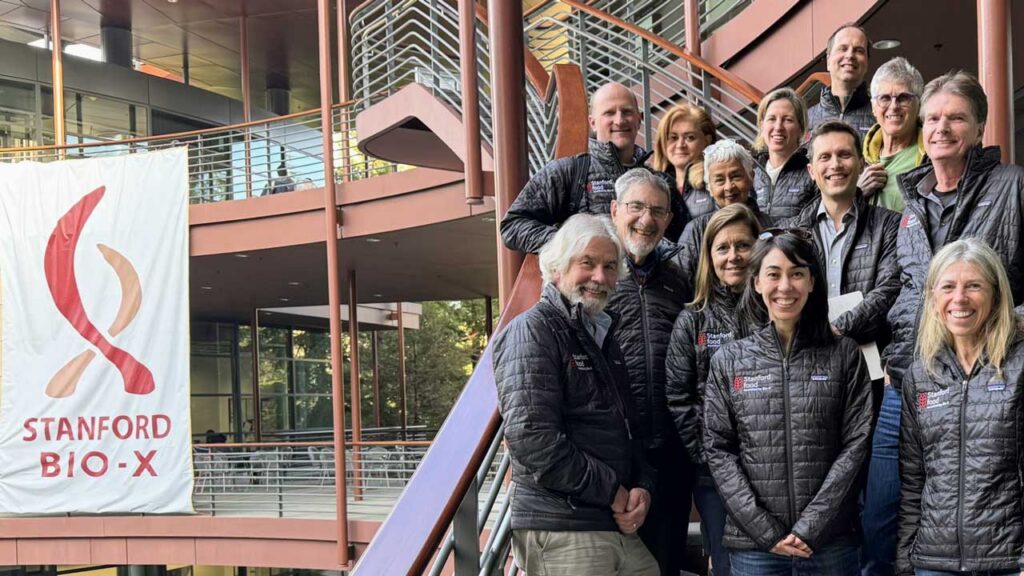
Image: Faculty and staff involved in the Food@Stanford effort, supported by Stanford Bio-X. Back row: Markus Covert, Heideh Fattaey, Elizabeth Sattely, Jonas Cremer, Pat Brown. Middle row: Richard Zare, Devaki Bhaya, Benjamin Good, Alfred Spormann. Front row Christopher Gardner, Mary Beth Mudgett, Jennifer Brophy, Ellen Kuhl. | Heideh Fattaey