




Researchers at Stanford have developed a new technology for removing blood clots that is more than twice as effective as current techniques
Breakthrough blood clot removal device doubles success rate
When treating an ischemic stroke – where a clot is blocking the flow of oxygen to the brain – every minute counts. The more quickly doctors can remove the clot and restore blood flow, the more brain cells will survive, and the more likely patients are to have a good outcome. But current technologies only successfully remove clots on the first try about 50% of the time, and in about 15% of cases, they fail completely.
Researchers at Stanford Engineering have developed a new technique called the milli-spinner thrombectomy that could significantly improve success rates in treating strokes, as well as heart attacks, pulmonary embolisms, and other clot-related diseases. In a paper published June 4 in Nature, the researchers used both flow models and animal studies to show that the milli-spinner significantly outperforms available treatments and offers a new approach for fast, easy, and complete clot removal.
“For most cases, we’re more than doubling the efficacy of current technology, and for the toughest clots – which we’re only removing about 11% of the time with current devices – we’re getting the artery open on the first try 90% of the time,” said co-author Jeremy Heit, chief of Neuroimaging and Neurointervention at Stanford. “It’s unbelievable. This is a sea-change technology that will drastically improve our ability to help people.”
Taking advantage of tangles
Blood clots are held together by tangles of fibrin, a tough, thread-like protein that traps red blood cells and other material to form a sticky clump. Typically, doctors try to remove them by inserting a catheter into the artery and either vacuuming up the clot or snaring it with wire mesh. But these methods don’t always work and can snap the fibrin threads, causing pieces of the clot to break off and get lodged in new, harder to reach places.
“With existing technology, there’s no way to reduce the size of the clot. They rely on deforming and rupturing the clot to remove it,” said Renee Zhao, assistant professor of mechanical engineering and senior author. “What’s unique about the milli-spinner is that it applies compression and shear forces to shrink the entire clot, dramatically reducing the volume without causing rupture.”
The milli-spinner, which also reaches the clot through a catheter, consists of a long, hollow tube that can rotate rapidly, with a series of fins and slits that help create a localized suction near the clot. This applies two forces – compression and shear – to roll the fibrin threads into a tight ball without breaking them.
A close-up of the milli-spinner shows a long, hollow tube with fins and slits that generate suction. Through this innovative design, it shrinks blood clots without rupturing them. | Andrew Brodhead
Imagine a loose ball of cotton fibers. If you press it between your palms (compression) and rub your hands together in a circle (shear), the fibers become a smaller, denser ball. The milli-spinner does the same with fibrin threads in a clot, using suction to compress the clot against the end of the tube and spinning rapidly to shear it.
Zhao and her team showed the milli-spinner could reduce a clot to just 5% of its original volume. The process releases red blood cells, which move normally once freed from fibrin, while the fibrin ball is removed through the catheter.
“It works so well, for a wide range of clot compositions and sizes,” Zhao said. “Even for tough, fibrin-rich clots, which are impossible to treat with current technologies, our milli-spinner can shrink and extract them using this simple yet powerful mechanics concept.”
A surprising success
The milli-spinner is an evolution of Zhao’s work on millirobots – tiny, origami-based robots designed to swim through the body. The spinning fins were initially developed for propulsion, but the team discovered they created powerful suction, prompting new experiments.
“At first, we simply wondered whether this suction could help remove a blood clot,” Zhao said. “But when we tested it, we saw a striking color change from red to white and a huge reduction in volume. It felt like magic.”
Motivated by the unexpected results, the team investigated the mechanism and iterated on the design to optimize it for medical use. Now, they’re developing an untethered version that could navigate vessels independently to find and remove clots.
Beyond stroke treatment, the milli-spinner is being explored for other uses, such as capturing kidney stone fragments with localized suction. “We’re exploring other biomedical applications, and even some beyond medicine,” Zhao added.
Knowing its life-saving potential, the team has launched a startup and licensed the technology from Stanford. Clinical trials are planned soon to bring the milli-spinner into real-world use.
“What makes this technology truly exciting is its ability to reshape and compact clots, not just extract them,” said Zhao. “We’re working to bring this into clinics where it could dramatically improve thrombectomy success rates and save lives.”
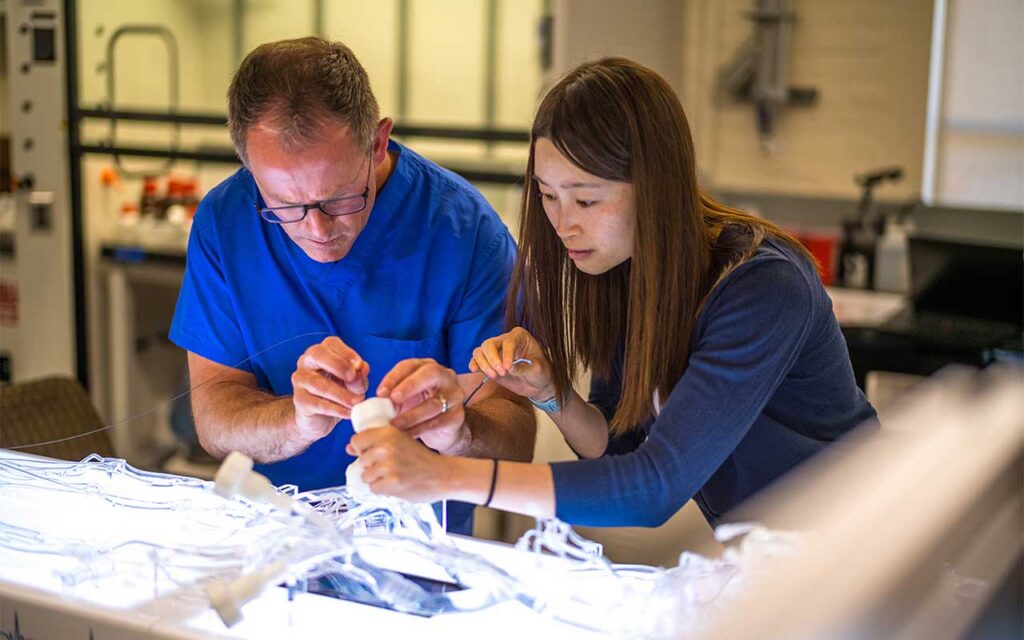
Photo: Stanford faculty Jeremy J. Heit and Renee Zhao demonstrate how to insert the milli-spinner using a life-sized model of the human circulatory system. | Aaron Kehoe