




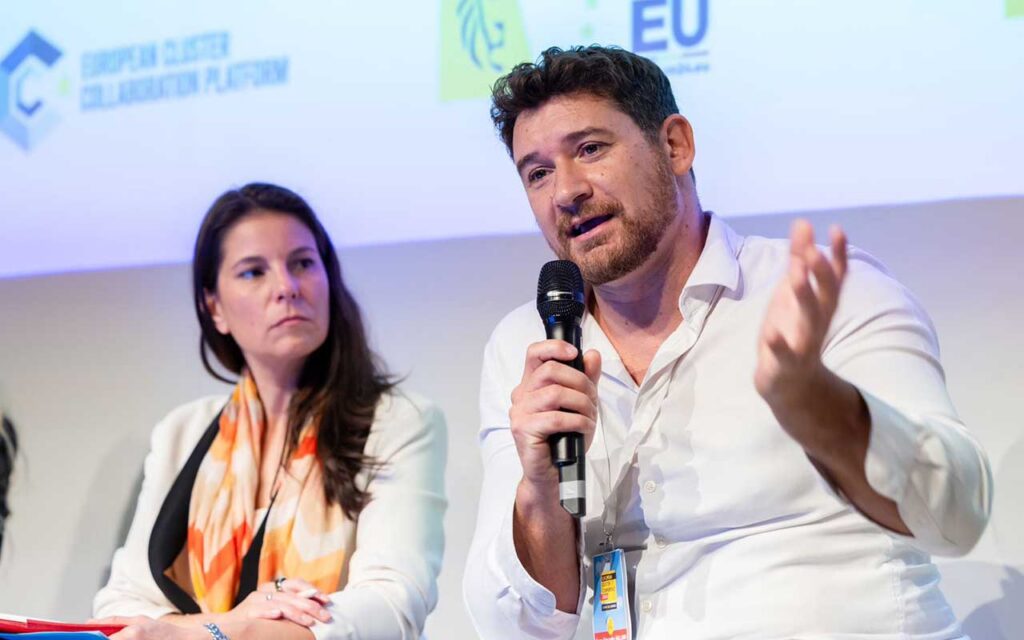
Professor Pierre-Alexandre Balland states, “We need to increasingly connect smaller regions to larger hubs.”
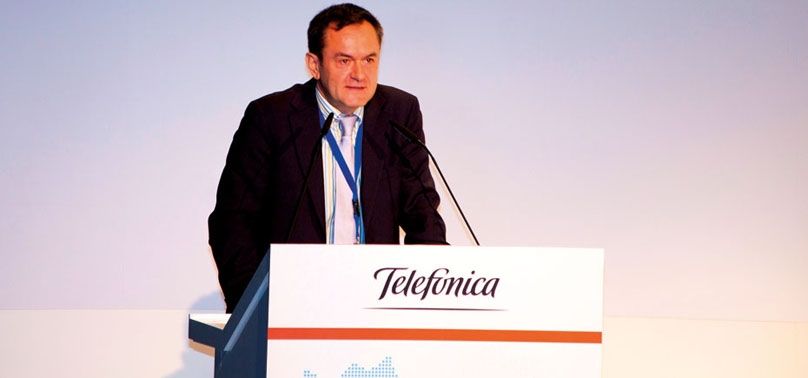
In the dynamic arena of the European Cluster Conference in Brussels, I had the privilege of engaging with Prof. Pierre-Alexandre Balland, a prominent French economist and leading authority on complex systems, urban futures, and emerging technologies. As an expert in Complex Systems Studies, Prof. Balland brings a wealth of expertise to his role as a high-level policy advisor to the European Commission.
Prof. Balland offered invaluable insights into the strategic role of clusters in advancing Europe’s green transition and economic competitiveness.
TSCJ: How do you see industry clusters playing a role in fostering inclusive economic development across European regions? Can you provide examples of how policymakers can harness the potential of industry clusters to promote innovation while mitigating spatial inequalities?
PB.-There’s a tension between the concentration of knowledge that occurs. Hubs accumulate a significant amount of knowledge, which inherently means that other places will have less knowledge, correct? That’s that’s the way it works.
The concept is to avoid striving for equal distribution of knowledge because it doesn’t align with how knowledge dissemination operates. Similar to how airports operate by structuring and focusing on hubs. For example, Barcelona airport is larger than Majorca, which in turn is larger than Ibiza. This system involves certain airports becoming super hubs and connecting to smaller airports. This approach maximizes knowledge diffusion, making the entire system highly efficient. Why? Because if you had a point-to-point network, imagine connecting Mallorca to every university in the world; you would have too many links, making it unfeasible. The same principle applies to innovation networks.
The first point we need to understand is the nature of innovation systems: some regions innovate more than others. This isn’t a flaw; it’s a feature. It’s not a problem to be fixed; in fact, it’s a positive aspect.
However, despite this reality, every region has a role to play in the innovation system, just like a small airport plays a role in the broader transportation network. It’s crucial to recognize that each region contributes to the innovation system.
How do we achieve this? By connecting smaller regions to larger hubs. Creating these connections isn’t automatic; it requires smart planning to ensure that regions invest in the right technology for their ecosystems.
One significant challenge in Europe currently is that many clusters are all chasing the same big tech trends, which is unsustainable. Therefore, we must align cluster specialization and investment with the local ecosystem, although this is a daunting task.
TSCJ: Who needs to support this effort to facilitate the situation?
PB.-This is an excellent question, and addressing it requires consideration of at least two layers.
At the national level, to be frank, its significance is somewhat limited. In Europe, the Member State level often exerts too much influence, leading to silos that hinder the scaling of innovation.
Ideally, what we need is a borderless innovation system in Europe. This is essential for scaling complex technology effectively. Take Airbus, for example, the aerospace company. It epitomizes this ideal; it’s truly European, with branches in various hubs across the continent. That model represents the perfect approach.
When you consider it as the key reference point, it becomes evident how we can develop super complex technologies like airplanes and space exploration and remain highly competitive, even surpassing Boeing. Airbus stands out as a prime example. It demonstrates that with a borderless innovation system, we can achieve remarkable feats.
However, this also highlights one of our greatest challenges. The footprint of member states often disrupts this innovation system rather than enhancing it.
So, when addressing the question of who should be in charge, the top level seems most appropriate. Entities like the EU are better suited for this task. Additionally, at the regional level, or within clusters, there should be alignment. Picture a captain guiding a ship; ideally, the European Union would fulfill this role at the top level, while clusters operate at the regional level, wielding more authority. This means reducing the power of states and empowering both the EU and local entities.
TSCJ: How do you envision leveraging the concentrated nature of innovation to prioritize and direct investment into clusters effectively, ensuring both local capabilities and global competitiveness? Furthermore, how can we enhance the resilience of these clusters while avoiding the pitfall of spreading resources too thin?
PB.-So that’s the how. If we just discussed what, now is the time to see how we do it.
We need an extremely detailed mapping of the regional capabilities. So we need to know what regions are doing, and from complex systems, there is a framework that allows you to do this matching. Because it’s a matching problem; it’s a bit like matching your taste to the movies on Netflix.
We need to do a much better job of developing algorithms and data-driven methodologies, and there are really good ones out there. They are starting to diffuse, especially in the context of smart specialization, but it’s not diffusing enough.
So way too often what you have is, when you look at the strategies, the smart specialization strategies you see that they’re not necessarily in line with the capabilities of the region.
What does that mean? it means that regions are changing a bit too much in the same kind of fields and not enough of the ones that are really connected to what they can do and that creates an immense amount of failure and wasting of money.
So again, it’s all about mapping the capabilities precisely and selecting the right technologies. In our study, and hundreds of other studies, it’s a specific topic. You can identify 250,000 different technologies. That’s a lot!
So how can you have all this knowledge in the brains of people? Focus groups and domain expertise are not enough. It’s not enough because we have a very myopic behavior, meaning we cannot see everything else that is not super closely connected to what we are now.
So you need to have a global perspective to evaluate what we call a “relative comparative advantage.”
When you decide, for instance, to invest in biotech or AI — and when I say AI, I mean in the AI field — it’s not because you have some capabilities in the ecosystem. It’s because compared to other regions in the world, you have a stronger capacity, and a real potential to take the lead because we live in a world where being the second best is not enough anymore.
You have to find niches and then go in and specialize. Otherwise, competition is just too tough on a global scale.
TSCJ: So is this informing the specialization framework?
PB.-Smart specialization essentially boils down to aligning your objectives with your existing capabilities. It’s a tailor-made strategy that originated from the research and innovation sector of the European Commission, specifically from DG RTD, before transitioning into the Cohesion Policy under DG Regio.
This approach serves as a framework to address regional inequality and has proven to be quite effective. Its principles are robust and applicable beyond regional development, extending to clusters and innovation policy at large.
The key principle behind smart specialization is what we refer to as “relatedness.” This concept acknowledges that regions possess sectors that are more interconnected than others. This interconnectedness makes it easier for a region to specialize in a new technology.
To illustrate, consider the analogy of Spanish and Italian languages. They are closely related, so someone proficient in Spanish would find it easier to learn Italian compared to Japanese. Technology operates similarly. For instance, transitioning from cybersecurity to IoT is more feasible than moving into biotech due to the significant differences between these fields.
We can apply these complexity principles to devise a robust strategy. This constitutes one aspect of the framework.
The other aspect concerns the value added by technology, which we refer to as the level of complexity. This essentially evaluates the economic impact of the technology. For example, AI holds greater transformative potential compared to carbon capture. While carbon capture is crucial for the green transition, it lacks the same level of transformative power as AI.
When considering both factors together—proximity to your existing capabilities and the potential economic benefit of specialization—it becomes clear how to direct investments effectively. We need to adopt a more structured approach to avoid resource wastage.
TSCJ: Knowing all this, how can we strategically design and implement industrial clusters to accelerate the achievement of sustainability and just transition goals outlined by the European Green Deal?
PB.-I’d like to add something here. The green transition encompasses two dimensions. Firstly, there’s the aim to achieve net-zero emissions in Europe by 2050. However, this constitutes only a small fraction, about 9%, of global CO2 emissions. While crucial for Europe, achieving net zero alone isn’t globally significant.
Where Europe truly stands out is in pioneering the technologies of the future and clean technologies. These include not only carbon capture, but also solar power, various forms of mechanization, and a plethora of other green technologies.
This is where industrial clusters come into play. Europe leads in green technologies, although it lags behind in the digital sector. Clusters are vital for producing clean technologies that can be adopted globally.
To illustrate, we’ve conducted a comprehensive report highlighting approximately 25 to 30 twin transition technologies, spanning both green and digital sectors, such as biofuel, carbon capture, solar, and geothermal technologies.
Different clusters across Europe specialize in various areas, enabling them to excel in producing these technologies. Ultimately, these technologies can be disseminated and utilized worldwide to mitigate the carbon footprint on a global scale.
That’s the key to aligning with the green transition.
TSCJ: Summing up our discussion, it’s evident that smart specialization and industrial clusters play pivotal roles in driving innovation and sustainability. By aligning objectives with capabilities and prioritizing clean technology development, Europe can spearhead the green transition while fostering economic growth and addressing regional disparities.
With a strategic focus on twin transition technologies and collaborative efforts across clusters, we can chart a course toward a sustainable and prosperous future.
Esther Fuldauer, The Smart City Journal