



Helmholtz Munich researchers develop the largest open-access database on microscopic images of bone marrow cells to date to boost AI.
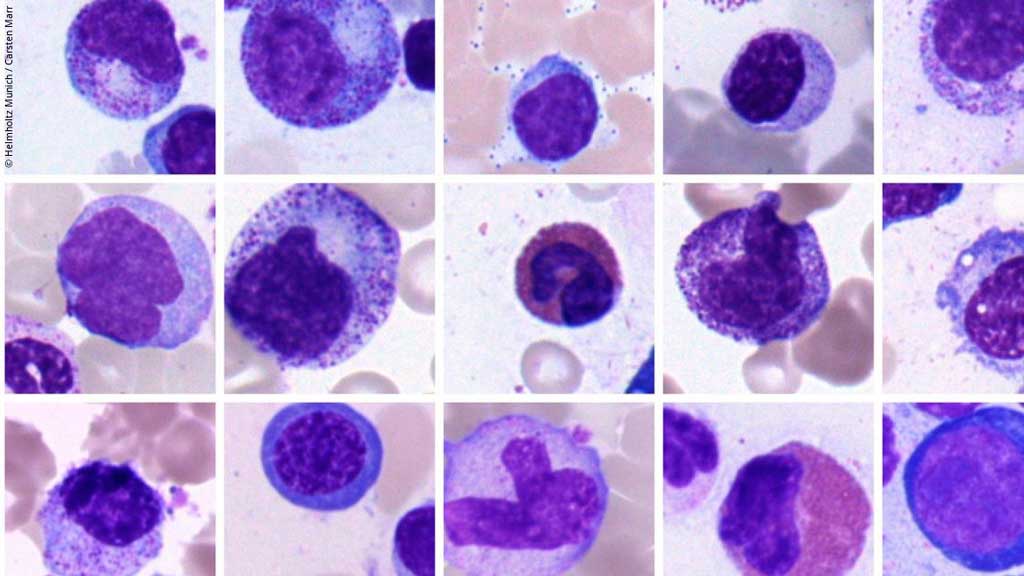
Every day, cytologists around the world use optical microscopes to analyze and classify samples of bone marrow cells thousands of times. This method to diagnose blood diseases was established more than 150 years ago, but it suffers from being very complex. Looking for rare but diagnostically important cells is both a laborious and time-consuming task. Artificial intelligence (AI) has the potential to boost this method – however, it needs a large amount of high-quality data to train an AI algorithm.
Largest open-source database for bone marrow cell images
The Helmholtz Munich researchers developed the largest open-access database on microscopic images of bone marrow cells to date. The database consists of more than 170,000 single-cell images from over 900 patients with various blood diseases. It is the result of a collaboration from Helmholtz Munich with the LMU University Hospital Munich, the MLL Munich Leukemia Lab (one of the largest diagnostic providers in this field worldwide) and the Fraunhofer Institute for Integrated Circuits.
Using the database to boost artificial intelligence
“On top of our database, we have developed a neural network that outperforms previous machine learning algorithms for cell classification in terms of accuracy, but also in terms of generalizability,” says Christian Matek, lead author of the new study. The deep neural network is a machine learning concept specifically designed to process images. “The analysis of bone marrow cells has not yet been performed with such advanced neural networks,” Christian Matek explains, “which is also due to the fact that high-quality, public datasets have not been available until now.”
The researchers aim to further expand their bone marrow cell database to capture a broader range of findings and to prospectively validate their model. “The database and the model are freely available for research and training purposes – to educate professionals or as a reference for further AI-based approaches e.g. in blood cancer diagnostics,” says study leader Carsten Marr.