




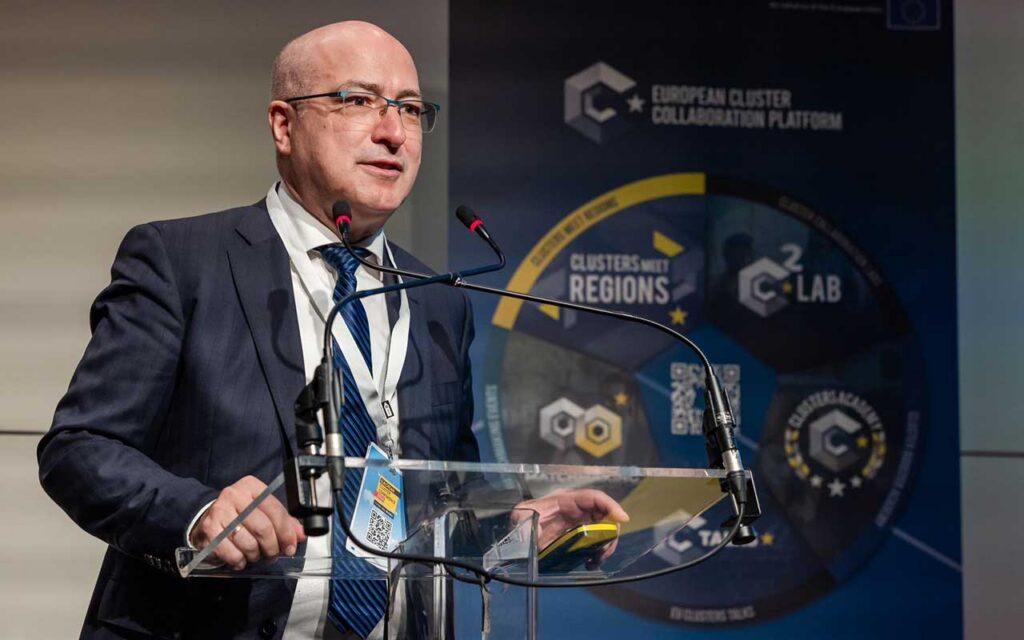
Antonio Novo, President of the European Clusters Alliance, highlights the role of clusters in uniting industrial efforts to achieve common goals such as sustainability and innovation, demonstrating a quick and efficient response to emerging challenges.
During the European Cluster Conference organized by the European Cluster Collaboration Platform, we had the privilege to speak with Antonio Novo, who holds the presidency of the European Clusters Alliance. This alliance, which brings together around 900 European clusters through cluster networks managed by both private and public entities, maintains a close relationship with the European community.
In our conversation with Antonio Novo, we explored the fundamental role of clusters. From the need to strengthen cluster policies at the European level to the importance of collaboration between regions and clusters to address common challenges, Novo provides an enlightening perspective on how these structures drive innovation and industrial competitiveness in Europe.
TSCJ.- Is there a need for a transversal regulatory body to lead clusters in Europe?
AN.- The European cluster policy has been in place since 2005, promoting an extensive network of 1,500 clusters and more than 10,000 industrial collaboration professionals dedicated to them. This conference brought together 500 representatives of that network. The great value of this network has been demonstrated during recent crises, and being a fundamental tool in the face of current challenges, it is clear that it needs to be strengthened.
As Kerstin Jorna, Director General of DG GROW EC, stated, clusters are at the center of the solutions Europe needs. Industrial collaboration is key to our future: “If there’s a problem, clusters are the solution.”
However, this European policy is not implemented uniformly across all member countries. Wealthier countries have more and better cluster policies. For example, Germany has 480 clusters, France 350, and Spain 130, while countries like Bulgaria lack structured cluster policies.
We need greater support for the development of clusters in these countries, to structure their industrial collaboration and foster their growth. The problem is not the lack of a European cluster policy, but the need to reinforce and extend it.
During the conference, we discussed the importance of supporting not just a small group of excellent companies, but also the majority, to avoid losing competitiveness. Strengthening or creating innovative industrial ecosystems should benefit a large number of companies, facilitating the rapid adoption of innovation by hundreds of thousands of businesses.
When Kerstin Jorna said “we need to redesign European funding schemes,” she was referring to how to redirect investment to innovative companies, how to convince investors, and how to be more efficient in supporting a strong industry, but not a minimal number of companies.
TSCJ.- Is this related to the smart specialization framework?
AN.- Yes, they are related. I am a member of the expert group on Smart Specialisation Strategies (S3) of the European Commission, under DG REGIO. Clusters often originate at the regional level, facilitated by the proximity of companies.
In the process of defining and executing the S3, the participation of clusters is recommended as intermediary agents linking regional strategies with practical applications in businesses and the economy. Most projects submitted to Interregional Innovation Investment (I3) calls are led by clusters, supporting connections with the industry.
Another change currently being discussed at the level of not just DG Grow but also DG Regio is the shift in the orientation of strategic priorities. Until now, they have mostly been defined based on sectors. Now, there’s talk of working based on missions. For example, being better prepared for the defense of Europe. This approach allows actions to be adapted to circumstances at any given time, introducing necessary modifications to agreed plans. Europe has some very clear missions: sustainability, digitalization, reduction of strategic dependencies…
Another clear example is the case of smart cities. Can you support a smart city sector? The sector does not exist. But we can define missions where smart cities play a fundamental role. For example, improving the quality of life in smart city environments. Specific challenges may vary year by year. A new challenge, for example, is the incorporation of generative AI into society: how to help citizens use it ethically and responsibly and avoid manipulation through AI?
In the face of these challenges, we propose promoting mission-oriented innovation ecosystems where clusters play a fundamental role.
TSCJ.- What do you think about the level of collaboration and communication between clusters from different regions? Could there be a tacit problem of lack of communication existing in Europe?
AN.- Yes, we need to improve collaboration between regions and member states.
While clusters are born as regional entities, collaboration between clusters and regional or national networks is essential to achieve capacities that allow competing globally and facing common missions. The European Commission is supporting the creation of strong interregional networks, on a European scale, such as the 30 Euroclusters launched in September 2022. European platforms and innovation valleys, generally led by clusters, are converging, addressing previous gaps. Progress is visible, especially in improving the coordination of networks at the European level. It should be reinforced.
TSCJ.- What is your overall vision of the European Cluster Collaboration Platform event and what positive conclusions can be drawn regarding the concrete progress achieved?
AN.- The European cluster community has advanced and matured significantly.
This conference brought together representatives from more than 100,000 companies, highlighting the ongoing dialogue with the businesses that are our foundation and the real commitment to innovation.
The quick response capability of clusters was evident during the COVID-19 pandemic and the Ukraine crisis, demonstrating our efficiency in engagement and industrial response.
Ahead of the upcoming European elections, we have reached clear proposals for the next period, reinforcing the role of networks and especially clusters. We propose strengthening innovative industrial ecosystems as a fundamental agent for the economic and social development of a much stronger and more competitive European Union.
TSCJ.- I see that it is a great advantage to work with clusters to really achieve European goals on time, by shortening the distance with companies.
AN.- Clusters reflect the spirit of European collaboration, driven by industrial social responsibility towards shared missions such as sustainability.
For example, in 2021, clusters quickly mobilized their extensive network in support of the Task Force created by the European Commission to increase vaccine production capacity, identifying 19 European projects and involving 247 companies in just one week. These coordinated efforts are unparalleled, demonstrating the impact and responsiveness of clusters.
We have done this several times during recent emergencies. In each case, we reacted with this capacity for network impact and industrial response. Because when you communicate a mission that the community understands and shares, many companies react with responsibility and dedication. We channel and operationalize that common will.
Esther Fuldauer, The Smart City Journal