


Compared with 2019, the circularity rate increased by 0.8 percentage points. The rate has maintained a stable growth trend since 2004 (8.3%), the first year for which data are available
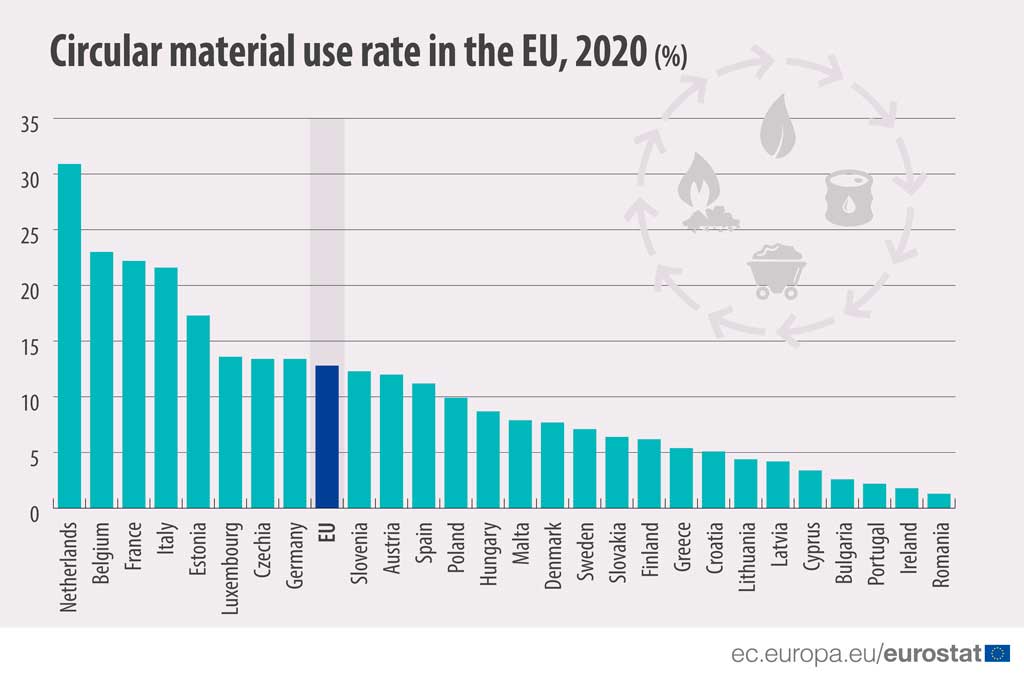
In 2020, the EU’s circular material use rate (referred to as the circularity rate) reached 12.8%. This means that almost 13% of material resources used in the EU came from recycled waste materials. This information comes from data on circular material use rate published by Eurostat today. The article presents a handful of findings from the more detailed Statistics Explained article on circular economy – material flows.
Compared with 2019, the circularity rate increased by 0.8 percentage points (pp). The rate has maintained a stable growth trend since 2004 (8.3%), the first year for which data are available.
The circularity rate is the share of material resources used which came from recycled waste materials, thus saving extractions of primary raw materials. The circularity rate is part of the EU monitoring framework on the circular economy.
In 2020, the circularity rate was highest in the Netherlands (31%), followed by Belgium (23%) and France (22%). The lowest rate was recorded in Romania (1%), followed by Ireland and Portugal (both 2%). Differences in the circularity rate among the Member States are based not only on the amount of recycling of each country but also on structural factors in national economies.
Depending on the main type of material, the circularity rate also presents some considerable differences, but small increases were registered in all 4 categories. In 2020, the circularity rate for metals was 25% (+0.7 pp compared with 2019), for non-metallic minerals (including glass) 16% (+0.7pp), biomass (including paper, wood, tissue, etc.) 10% (+0.2 pp) and fossil fuels 3% (+0.5 pp).
Source dataset: env_ac_cur